MacMacMac
EssBrace ... this endless rabbit warren of pointlessness ...
Poetic ... and correct.

EssBrace ... this endless rabbit warren of pointlessness ...
Poetic ... and correct.
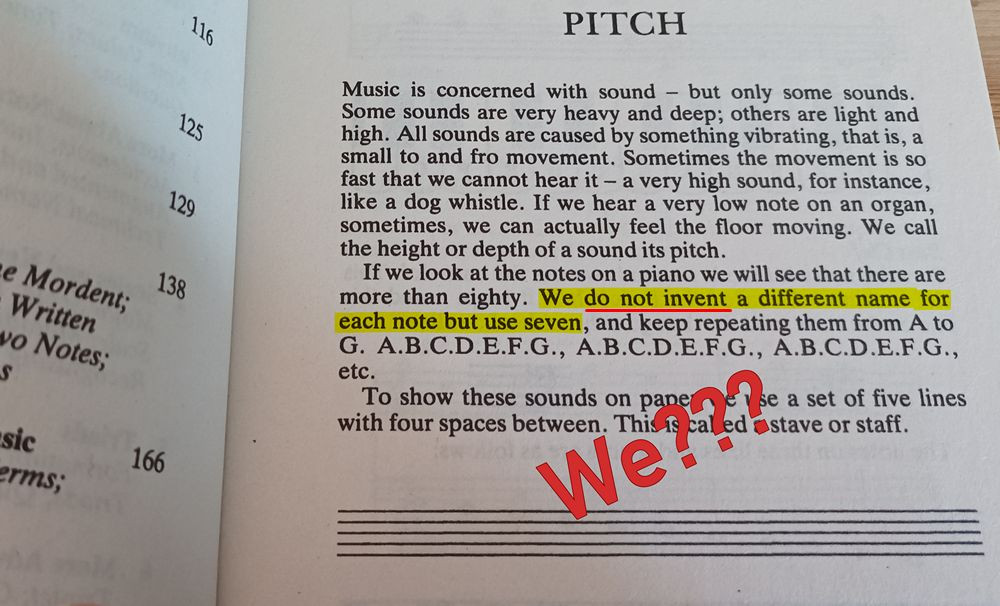
Yes, interesting indeed. But you will have to agree that someone just sat one day and said:
"This key will be… I do not know… can not think about names, so I speak Latin and know Latin alphabet, so why not, that key will be A, the next B, then C and till G.".
The History tells us a different story. Since 500 CE when Boethius (latin speaking clerk and Music theorist) when he worked on Music related subject he named the intervals, contrary to what many people assume that he named the notes, and he used the Latin alphabet. Because of that and the extended musical intervals bigger than a renova ("octave") he used more than 8 and 12 intervals therefore letters (the letter J did not exist in his time, by the way).
They had no concept of pitch as vibration per second (Hertz) as Hertz would be born 1400 years later.
There were no "white and black key" pianos back then either – merely some leves on portable pipe-type organs with a bellow at the back or a crank to move it, so they used only one hand to actually trigger notes on the levers.
So, we have to "travel" back in Time in our minds to understand the picture. In those medieval times they had no notes at all. Boethius used the diatonic genera (we can say on the 'white keys only' as there were no "black" keys) although it was not the typical music among people\folk (euronean church music was only emerging in his time) where folk music existed thousands of ears before that. But those portativ organs had levers where you could write a symbol – other instruments did not have (even on flutes\whistle instr. you can not do it becuase a note is usually a combo of a few fingers). Yet, there were no note names despite the fact that Apypian notation existed 200+ years before Boethius and most likely he knew about it as he mentions it in his work. That system used chromatic (wrongly known as half-tone passages) and enharmonic genera (the latter today we associate with micro-tonality but it was not off of n-Equal temperament nature).
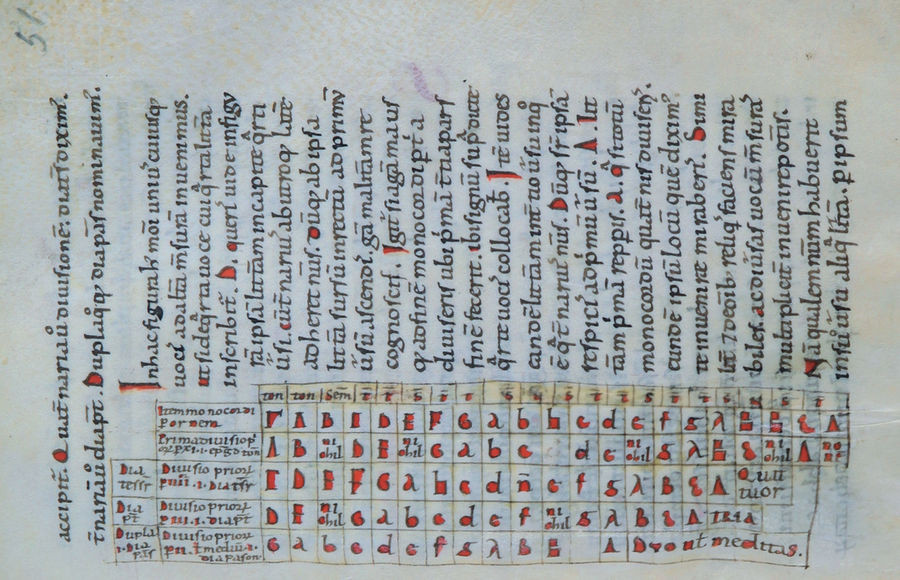
The actual naming of notes started by an ignorant application of both Boethius interval naming and Aristoxenus' 'division of genera' by the church monks\clerks Odo ("Musicae artis disciplina"), then Guido and Theodaldus around year 1017 (500 years after Boethius).
They started with a string (not keyboard+pipes) only "god" knows at what pitch and started dividing it in order of bigger to smaller (contrary to how Pythagoras started) because they used the divisions already documented by Aristoxenus (no written work\evidence we have from Pythagoras anyway). Oddly enough (as ironic fate can be!) they named the string with the greek letter Г (it is the third letter in Greek alphabet, which phonetically in Latin is G – the seventh letter) because, I kid you not, this is what they say to each other:
"On the monochord string, at the attachment pin, make it as the letter Г (gamma), that is – the Greek G, which, because no one knows it here.". Then they proceed without any understanding and explanation how to match the diatonic genera starting with what Aristoxenus called 'a tone' and call it A (in their Latin alphabet but also it is in Greek an Cyrillic). The ignorant thing is that in the first half they do not encounter what is known as B♭, but in the next renova ("octave") they see it in the ratios (they get smaller → better "resollution") and have no idea how to call it. So they write it es a 'square' shaped b:
"Et dum voces per medium diviseris,
dissimiles easdem litteras facere debes.
Verbi gratia, dum a Г per medium dividis,
et pro Г scribe G, et pro A mediata pone
similiter a, similiter quoque et pro B aliam ♮.
Praeterea et a voce sexta F per IIII divide,
et retro B aliam ♮ ivenies b quam dicimus rotundam." (the round b is actually known to you as 'B flat')
"Alius vero dividendi modus sequitur, qui etsi memoriae minus adiungitur, eo tamen monochordum velociori celeritate componitur, hoc modo:
Cum primum a Г ad finem novem passus id est particulas facis,
primus passus terminabit in A, secundus vacat, tertius in D,
quartus vacat, quintus in a, sextus in d, septimus in aa, reliqui vacant.
Item cum ab A ad finem novenis partiris, primus passus terminabit
in B, secundus vacat, tertius in E, quartus vacat, quintus in ♮, sextus in e, septimus in a', reliqui vacant."
in English:
"And when you divide in half, write the same, but not exactly the same, letters. For example, when you divide the other half from G, write G instead of Г; dividing A in half, write a, and likewise, instead of B, put ♮. Also, divide the sixth step by 4 and before that B [square] ♮ you will find the other b, which we call round." (the latter is what you know as B flat)
"There is another way of dividing, which is not so easy to remember, but it measures the monochord faster. First divide the whole string from Г into 9 segments or equal small parts: the first segment is as A, the second is skipped, the third on D, the fourth is skipped, the fifth on a, the sixth on d, the seventh on aa, the rest are omitted. Now divide in 9 parts the remaining part of the string from that A to the end: the first segment ends on B, the second is skipped, the third on E, the fourth is skipped, the fifth on ♮, the sixth on E, the seventh on a', the rest are omitted.
It is obvious they were doing it as a perscribed method without any understanding and placing letters on the go.
Still, can we assume that they tuned the Г to the key on a portativ (where later in time wold be G)? So the next higher note would be A and then even later in Time they will make the key 'B flat' an 'accidental'?
At the time of those dialogues and instructions among those church clerks, they rarely used B♮ (h in German music notation) and B♭.
They ruined all the work of Aristoxenus and Alypius. I would even argue that they had no idea about their work and used only the diatonic ratios as instructional method for finding the diatonic notes.
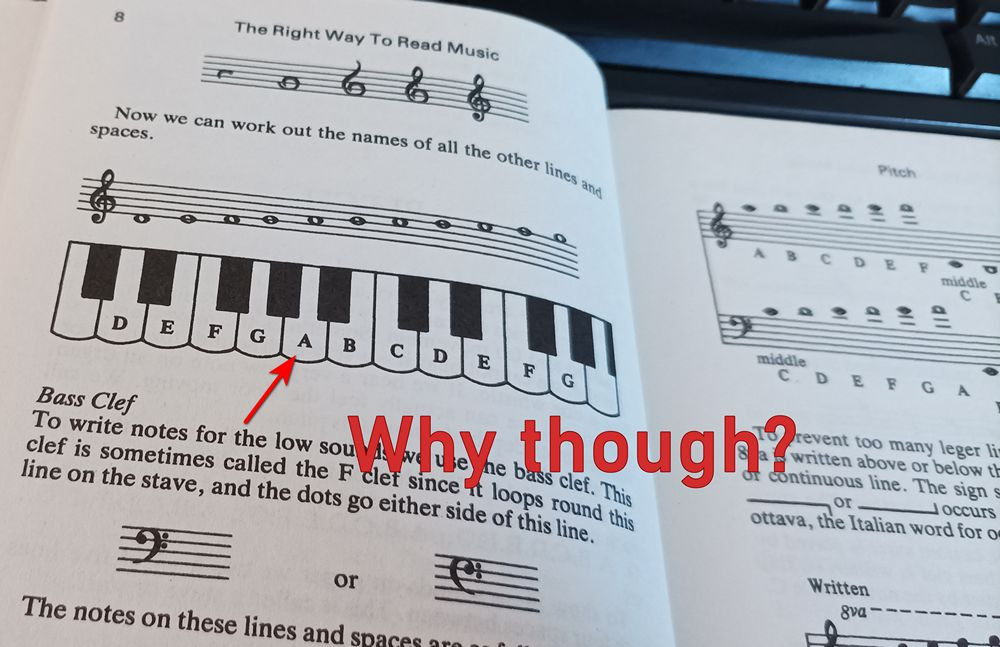
Still, we (at least I) have no idea why A on a piano is where it is today?!
Because, lets say you have already fulli developed piano (7 white + 5 black) keys and you are given the chance to name the notes, what will you do and how will you procede?
Because I did exactly that. And I do not care what some "academic" established copy-paste (historically) teacher tells me in the Music theory notebooks. They do not explain why. They just tell me it is as it is. This is how indoctrination works!
I do not buy this. At all.
EssBrace
That is your opinion.
I describe myself as logical and inventive, maybe creative also (despite this is a cheesy buzz word).
Not innovative – it has no meaning. We all stand on the shoulders of those before us (as Newton has said… if I remeber correctly, but probably much older sentence).
My other interests are playing guitar (drums not so much these days – only VSTi ones), CAD (Math and Geometry, especially geometric methods of finding roots, which are not taught in schools for whatever reason), art (although I can not draw as painters would), Audio and Video mixing\engineering, cycling (not as pro).
You insult this thread (topic) by calling it rabbit warren of pointlessness. Just skip it.
Yes, humans adapt… Now think about it again from the pespective of this topic here.
Ah, and please, get involved by attempting to answer my questions. Oh, you can't. You are a pro.
EssBrace How about learning to play the piano?
this+
i never understood the people who question the rules and norms all the time instead of just doing what should be done (no offence to anyone)
i had a friend that could never sing properly, but he also never said "our vocal cords" are badly designed, he knew it's an ability he must achieve by practicing.
that bosenforfer keyboard (i don't know if it's real or not) is something i'd love to try personally,
Vocal cords are "built-in" as our fingers' length. I wish I had longer fingers, but…
I wish I had a bigger and girthier… but.
That Bösendorfer does not exist. It was a illustration (render) I did when contacted Bösendorfer at the time they got acquired by Yamaha (I did not know that), so the Director told me they now comply to Yamaha's policy regarding R&D. ANd I already had contacted Yamaha before that. The one you see, is slightly updated render from ~8 years ago.
Oh, just to make it clear:
• there is no difference between a singer's (worldly famous or just a karaoke-pub famous) vocal cords and a total tone-def person's vocal cords (anatomically at least)
• as fingers – we all (usually) have 5 of those on each hand (some have 6 but that is another topic)
Yet, some people are craftsman others are not. Some speak fluetly, others have eerrs and uhhhms etc.
In this topic I discuss historically traceable problems. I would love all men could benfit form "bigger and gerthier" or all women to benefit from "bigger and jucier" both having perfect faces\skin but that is not going to happen.
It all comes down to inner feeling. There are many singers who can sing very good (right, correct), but they just sound generic. There are many talented instrumentalist, but their music is generic. And there are quite mediocre players who's music is great. Practice will make you a good "technician", not a great performer or entertainer.
And Music is all about entertaining and the spirit (inner peace or feeling).
PASHKULI I do not buy this. At all.
Then don't use it. It's not there for anything other than communicating ideas from one person to another.
Playing the piano is a physical skill developed through practice, and it seems like you're stuck in analysis paralysis.
I don't know of advanced players that think in terms of note names as they play… they might happen to know those labels quite well, but I suspect most of us are just playing the tones that live in specific physical locations on the keys.
If you want to write a musical idea down, it's a common practice to use something like sheet music or talk about a specific tone using a commonly known names and tune to a common reference frequency.
Same reason most international communication is in English… it's not a very elegant language, but it's well-known, and that's inherently useful.
Never used it. Although had to learn some of it at one point to tell some "educated" musicians what to play which I could not play (on a piano). You know, things such as Cmaj7 and so on (no melodies, just chords) so I could play\sing on top.
The point is, this so called 'Music system' combined with the terribly designed piano (most of it because of pure ignorance and understanding of human\natural anatomy) is in the heart of the "academic" or "pro" or even "international" collabration\communication. It is pathetic from my point of veiw and mainly feeds itself like a ponzi scheme as teachers impose it on children and so on, conservatories on students, now over Internet.
English is quite good. Still has two main problems:
• phonetic ambiguity (many langues have this, most notably French… among European languages) – just read\pronounce 'Pacific Ocean' and tell me which sound 'C' represents in it?
• S suffix in 3rd person verbs – does not make sense! All other forms have lost the conjugation suffix, only this obnoxious (short and irritating) S suffix has remained (with the exeption of the verb 'can': He can, not He cans); S is enough to make noun(S) in plural and that is ok.
But to have it 'fixed' would require an Official Normalised accent for Official pronunciation of words which is quite difficult task. At one point Latin was sort of "international" language but that is gone. I think in 100~200 years same will happen to English. And no, English is not a successor of Latin.
PASHKULI terribly designed piano
That's a very silly claim without a demonstration.
If your design is such an improvement, why not inspire a local pianist with your prototype, and they can demonstrate a quick virtuosic passage, perhaps after a little bit of practice? Or you could develop your technique on your new design and demonstrate yourself. Until then, I can't see how your design wouldn't get in the way on all but the most simple pieces, compared to the "terribly designed" piano.
This is no different than criticizing a common sneaker design before learning how to walk/run. Playing the piano isn't a mental exercise, it's a physical skill. You don't master it rationally/logically, you master it with your "lizard brain".
A demonstration is the only way to sell this idea, IMO.
Mindbullets
I have. Had a young student of Music in Oxford and she recorded Scarlatti, Mozart and Chopin (but only MIDI) as she was not keen on recording video – besides – it is not a real acoustic piano, just a MIDI keyboard prototype.
An older pianist (~50ish) got it for a month but did not record anything at the end. Just said he could play some weird things and the black keys were slimmer and he was "expecting more 'meaty' black keys", which is understandable.
I gave it (both) to some other students just to get them returned with a snapped pedal cable, coffie\tea splatters on some of the keys and messed up settings, they managed to turn off velocity. Not giving it anymore despite the local shop owner asked me to have them upstairs in the rehearsal room for kids (hell no!)… but I suggested to have them on display in the showroom… to which he did not agree (of course).
PASHKULI Cool. I hope you haven't given up on that -- despite my pessimism I am genuinely curious about this sort of thing. A video (even just of the hands -- the pianist could remain anonymous) of someone performing on your keybed would certainly help me draw some more informed conclusions about what only exists in my imagination right now.
Maybe you live close to @CyberGene ? He's a skilled pianist… maybe he'd give it a shot and provide some useful feedback for you and/or your target market?
Mac, Mac… Mac
Politely… skip this thread, mate. It is above your cognitive and intellectual abilities.
No one forces you to read it, let alone to post in it some moronic posts.
PASHKULI Mac, Mac… Mac
Politely… skip this thread, mate. It is above your cognitive and intellectual abilities.
No one forces you to read it, let alone to post in it some moronic posts.
Sorry, no. Trolling needs to be called out. And nonsense ought not be tolerated. And now insults? Sorry, no.
Your ego exceeds your intellect ... why else the endless, pointless ranting about piano defects from someone who doesn't play piano?
To everyone else: I stand by my assertion. Please don't feed the troll.
Just a heads-up. I’m going to tag this discussion with the “Personal” tag. This will keep it public (visible to non-registered members) but will hide it from the main list with all discussions. One can still browse to it through any of the other tags, “Pianos”, “DIY”, “Knowledge”.
Yet, questions are still here for any participant who would like to chime in and THINK, INVENT their own answer.
Not the copy-paste words they have read from a book written by another copy-paste academic.
Calling me a troll is an insult and it will backfire (trust me, I have seen a Music professor getting angry at my questions). If you (anyone) have nothing in mind to discuss and bring to the discussion, this thread is not for you. I do not mind. It is intended as a "placeholder" on the Internet for the search engines (eventually) although I would prefer participant to really think about the problems presented. Oh, you do not think there are problems! Good. Please, move on. There is no need to participate. It will only make you look stupid and childish. You just can't help yourself but to shit on other's people no matter how crazy or uncomfortable (for you) quests.
The forum has an Ignore function. Use it. I allready did for the following morons:
revox, MacMacMac, Pete14
Khuja is one moronic post from it.
PASHKULI If you (anyone) have nothing in mind to discuss and bring to the discussion, this thread is not for you. I do not mind. It is intended as a "placeholder" on the Internet for the search engines (eventually) although I would prefer participant to really think about the problems presented. Oh, you do not think there are problems! Good. Please, move on.
I think therefore you have a problem. If you think the only worthwhile contributors are others who agree with your basic premise, i.e., that the traditional piano keyboard is conceptually flawed then it's likely there will be no other contributors! Throughout your endeavours you've been a lone voice and you'll continue to be that I'm afraid. How many more doors (real or figurative) have to be closed in your face before you might be able to face the truth?
PASHKULI It is intended as a "placeholder" on the Internet for the search engines (eventually)
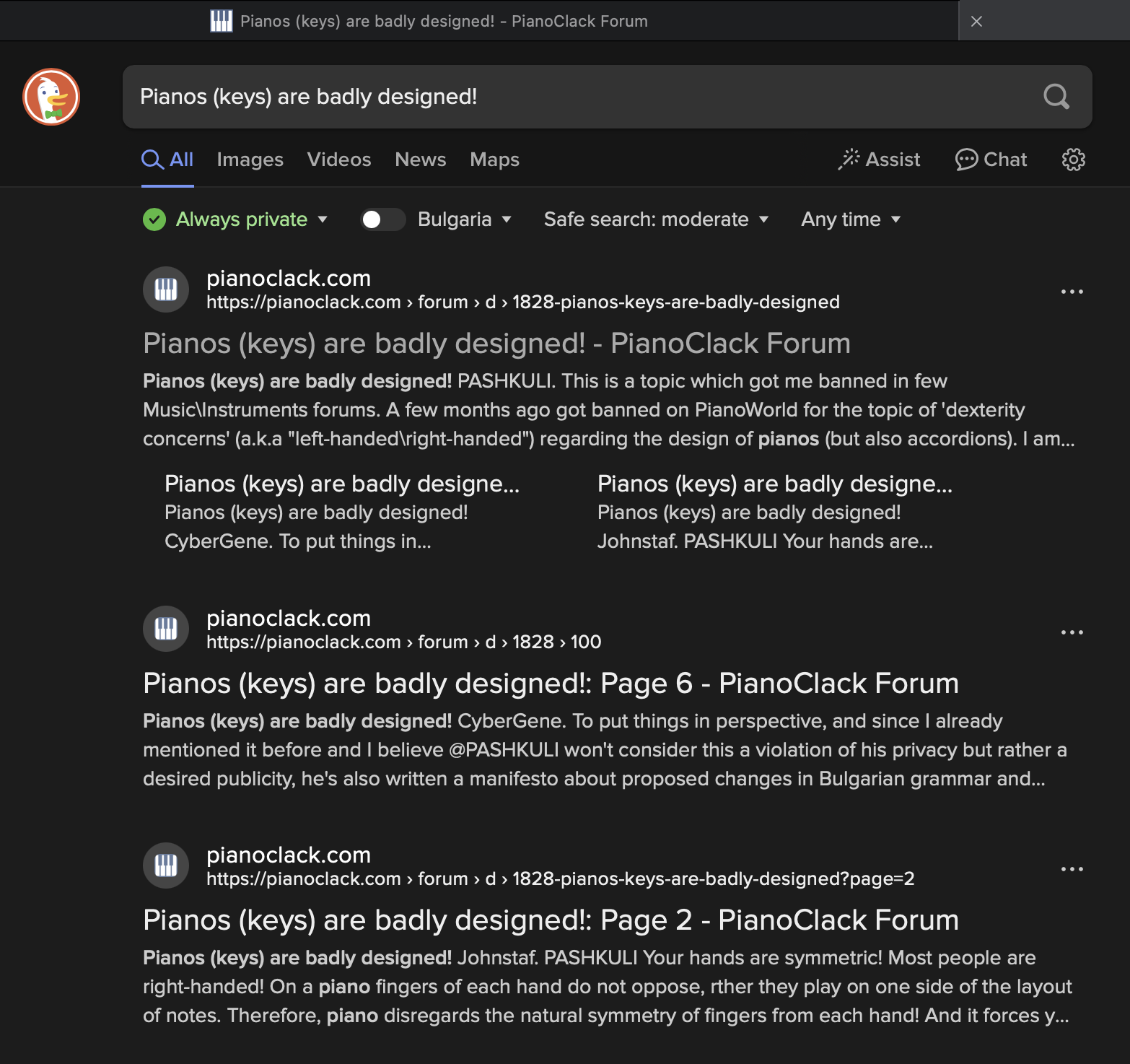
To answer to that concern (and the same one you messaged me about), this discussion is only hidden from the main forum view, it's still indexed by search engines and its forum URL is still the same. If I search for it in DuckDuckGo, the first few results point to it:
And to elaborate more on my decision to tag it with the Personal tag and effectively remove it from the main discussion list. I believe this forum is for piano enthusiasts, that's in the main description and welcome page of the forum. It's not for people who are not pianists and who think "pianos are badly designed". Bumping it with new content would naturally annoy and irritate the target crowd of a forum like ours. It will just create negativity and you've already noticed it. This is effectively trolling, although it may not be by-the-book trolling. If someone is interested, they can still find this discussion browsing through the tags explicitly. I find this more than fair enough for you.