
Skip to content

Build your own hybrid piano - step two, the cabinet

RIP

Deleted Having no speakers inside this cabinet would be a missed opportunity.

Thank you for your suggestion.

If by "cabinet" you mean the actual "enclosure", that volume is already 80% + filled with the action and once I have all the electronics, cabling, sensors, and rails to hold them, it will be close to 95% filled (don't have the specs on all of that). So what you call "missed opportunity" is either impossible or a "missed opportunity to place really tiny speakers in the only location available which may be acoustically inappropriate". Perhaps it won't be that bad with tweeters, but I assume you are talking of midrange and woofers instead.

On the other hand, if by "cabinet" you mean the "bottom", as you can see from the pictures and video, there is no "enclosure". I could make one on each side (leaving an empty part in the middle for the pedals) but that will be practically equivalent of building a pair of floorstanding speakers of a size which fits that location, and logistically that is much better (ease of construction, ease of installing, ease of move). So I might do that if the DML turn out disappointing, which they might given that their dimensions are also forced by the location of their installation -- and preliminary tests are not so good as with the 2'x2' square piece.

Deleted a traditional DP MIDI extender

That is interesting, years ago I was looking for something like that and I was unable to find anything like that, besides a few cheap ones on Amazon with no reviews.

For the time being, I think I will give PTQ a good shot, since it's supposed to be designed mostly to be played live, and in the tests which we run at https://pianoclack.com/forum/d/290-virtual-piano-comparison I actually liked it best than many others. If that is disappointing, I might give Garritan a try too. Only failing these options, I would consider the device which you suggest, which is good to know is an option, but a bit steep in price (compared to using some computer hardware I have, obviously if one has to budget a new computer, then the vivo is inexpensive).

Thanks again for the discussion and the congratulations 😃

Deleted

RIP If by "cabinet" you mean the actual "enclosure", that volume is already 80% + filled with the action and once I have all the electronics, cabling, sensors, and rails to hold them, it will be close to 95% filled (don't have the specs on all of that). So what you call "missed opportunity" is either impossible or a "missed opportunity to place really tiny speakers in the only location available which may be acoustically inappropriate". Perhaps it won't be that bad with tweeters, but I assume you are talking of midrange and woofers instead.

Full-range speakers might suit piano more than tweeters and woofers. But yes, you have actual cabinet suitable of properly projecting acoustic piano sound and completely filling that up with electronics is what I see as "missed opportunity".

RIP Only failing these options, I would consider the device which you suggest, which is good to know is an option, but a bit steep in price (compared to using some computer hardware I have, obviously if one has to budget a new computer, then the vivo is inexpensive).

The VIVO pricing is pretty appropriate for a hybrid piano build - you don't fire that with a Casio engine. It won't work out of the box in such a setup either, don't underestimate the audio skills required to build an actually well-sounding digital piano. However unlike Garritan CFX only providing various pre-mixed microphone positions, which are completely useless for cabinet use, Pianoteq Standard might give you enough settings to generate an appropriate audio input for a DIY cabinet amplification. Standard DP tone generators do too, though they might not expose all the processing settings to the end-user.


RIP

Deleted Full-range speakers might suit piano more than tweeters and woofers. But yes, you have actual cabinet suitable of properly projecting acoustic piano sound and completely filling that up with electronics is what I see as "missed opportunity".

I understand you point. However that is unfortunately impossible with the cabinet I have, as I describe below. It may be a good suggestion for the next person following my footsteps. I guess that's the nice thing of such a project in that every person embarking into it can find some ways to improve the predecessor.

I am not using the cabinet as a storage box for some random electronics and some acoustic piano action. I do need both of them to create the MIDI data driving the sound module. I am sure you totally agree wrt the action. For the electronics, I could probably migrate some parts elsewhere, but the vast majority (sensors, sensor rail, ADC) must stay there (the path from the sensors to the ADC must be short, otherwise noise will be picked). Then I either keep additional electronics there (e.g. computing modules to make use of the ADC raw data to create MIDI values) or I make a whole mess of cabling routing the ADC data to the computing modules located elsewhere. The latter won't provide any additional space in the cabinet.

If I were designing the cabinet from scratch, I could have made it taller and I could have the needed space, but as I described I was using what I had, and making it taller would have been a whole lot more of work (plus, I did not think about it, see previous comment about incremental improvements by each person embarking in this project).


RIP

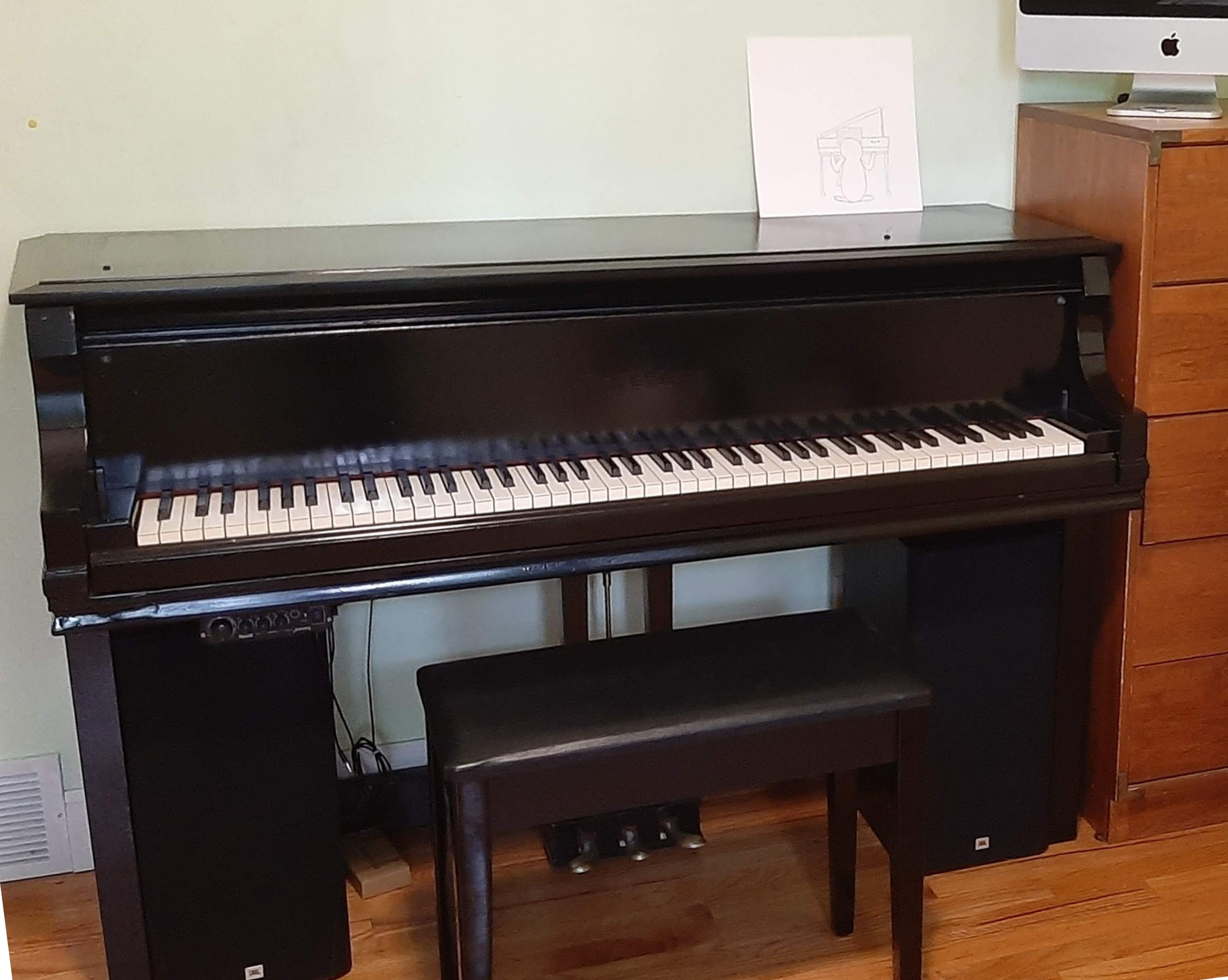
In the absence of updates on the electronics or other more juicy things, and given that I had to spend a lot of time moving things through the house since the kids wanted to play the game of 15 with all the bedrooms (and my office!) in the home, here is something to prove I'm not dead (yet 🤣).

The piano in its final location, including speakers and ampli (I don't think I ever posted a picture in such a configuration, regardless of location)


SouthPark

RIP Looks excellent.


RIP

Thanks to both, guys!


« Previous Page