DavisB
CH569W is 6.2eur at 10qty from LCSC.
It has gigabit ethernet and USB3.0 PHY, which explains the price, but why would that be necessary for USB-MIDI over MCU with integrated USB2.0 PHY? Other than various hi-speed peripherals, this MCU itself isn't particularly powerful for the price. What's the rationale here?
Keep in mind that CH569 is not on (https://github.com/hathach/tinyusb) supported MCUs list, which means you'd be on your own implementing USB-MIDI. Unless you plan to do that, I'd stick with devices on that list.
Some notable cost-efficient MCUs with integrated USB2.0 PHY (480mbit theoretical max) and tinyusb support are:
- CH32V305 (1-2eur in small quantities)
- AT32F405 (1.5-2eur in small quantities, 100kb sram)
- NXP MIMXRT1011 (500mhz cortex m7, 128kb sram, requires external QSPI flash for code(!!!), 2-3eur in small quantities)
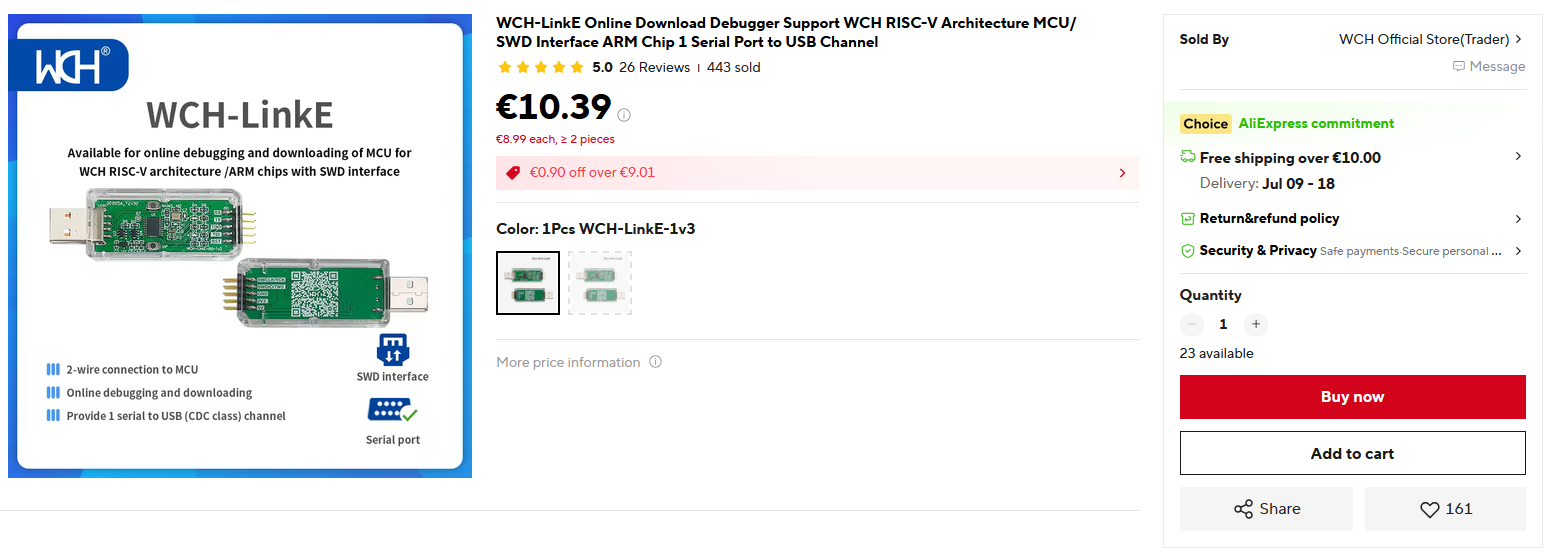
Another thing to note is that, WCH MCUs require a special SWD probe called WCH-LinkE, so you can't leverage existing probes you'd use for stm32 and various other arm-cortex based MCU.
WCH-LinkE used to go for 4-5eur a while back, but now after the newly introduced EU tariffs it costs more like 10eur (post tariff, price of of every little thing has been bumped for at minimum 4eur)
Another thing to keep in mind regarding USB2.0 HS is that you need impedance control for the differential pair (Zdiff = 90ohm). So unlike USB FS (where you can be very sloppy), you'll have to carefully calculate trace width and trace spacing as well as spacing to copper pour (especially on 2layer pcb), etc.
The difference between USB FS and USB HS (2.0) MIDI latency is somewhere around 1ms. It's not large enought to be a dealbreaker for the initial version, in my opinion.
So you can draw the MainBoard PCB for some USB1.1FS MCU (some widely available rp2040/rp2350 devboard) and then eventually upgrade to mcu with usb 2.0 when the rest of the system is ready.
I can't comment on MagnTek’s MT8901AT, it looks like something that would be used as rotary encoder for motors, etc. Not sure how exactly you're planning to use it for velocity sensing - although I highly suspect (due to how it's worded) that I'm replying to an LLMed post. 🙂