Skip to content

Cybrid - a DIY MIDI controller with grand piano action

vagfilm

CyberGene With a screw you can go one by one quickly.

But your screw adjust a spring, correct? So, it may happen that from time to time you still have to adjust the spring, and then fine tune with the screw, correct? So, german non renner actions are the easiest to regulate while being the most "agile"?


CyberGene

vagfilm

I am not an expert and have had experience with only one action so far 🤣 But what's interesting is on the Cybrid action that screw changes the spring tension even with a very small turn and the screw seemed to have many turns possible, and so I could regulate all springs without the need to also manually change the spring tension, although I also thought like you that this has its limit until you have to regulate the spring itself.

There may be other considerations here too and I'm far from saying that some 100-year old action is better than a Renner or Yamaha action 😀 But I simply can't understand why they would remove the screw unless for cost savings. In a Renner? 😉


vagfilm

Nothing like hands-on experience… sometimes the perfect is the enemy of the good. Thanks…


RIP

MBiG Frankly, I have no idea how expensive piano actions are, a consumer market doesn't really exist. I think it's great that you were able to repair/adjust the action yourself.

Of course it does not exist. Why would a consumer buy an action?

In any case, I did some research and I found that if you get it built on purpose in the "first world", you'd be paying easily $10k or more. Oddly enough (I was shocked to learn that), most of that cost is for the keys and keyboard frame, rather than the other more complicated parts which are relatively less expensive (because they are mass produced, unlike the keys that need to be custom made). If you can get access to the lowest tier of Chinese manufacturers (who often don't even speak English [1]), you can get one for 2k and perhaps even less (putting the dollar sign makes the PC go crazy [2]) -- after all there are some completed grand pianos which can be bought for less than 10k (ditto for the dollar sign), complete of everything from transportation to store profits…

On the used market, obviously is all over the place and it depends on the local conditions. For example, in some parts of the USA there is a huge availability of grand pianos because people need to vacate their houses for selling them, and as such the grand pianos become "peanuts" in the economics of the sellers but huge logistical nuisances to get rid of fast: hence they can be gotten cheaper than they are really "worth" (if you can define a "worth" outside of a market, which obviously you can't). None of these will sell the action itself, you have to take away the whole instrument (but then again, in the USA is also easy/cheap to get rid of the parts you don't need -- harder and more expensive in the parts of Europe I lived in)

[1]: but perhaps @Ampersand 's wife or @Picotin or @dore_m could help -- PM me if you want one referral of a Chinese speaking manufacturer which is well regarded but can't speak any other language than Chinese

[2]: @CyberGene can you please disable that thing that if there are two dollar signs in a post it gets interpreted as something else????


CyberGene

I think I see what the $ issue is. It happens when the rich-text editor is enabled - the fountain pen button. It seems that it would somehow assume that the text between two such dollar signs is some code, however after actual posting it is OK.

I went and checked the settings of the rich-text editor but couldn't find anything. However you should take in mind this extension is unfortunately experimental and still in beta. It allows you to immediately see your formatting in the text area instead of having to look at the preview window above. I think this may be a bug and I will ask on the extension discussion page. For now you should either live with that or switch rich-text editor while writing posts.


MBiG

RIP Of course it does not exist. Why would a consumer buy an action?

Perhaps there is a misunderstanding here again, which I have triggered. 😀

I myself do not want to buy a piano action. I am only interested in the history / technology of course only in the context of this hobby. (for me this is also only a hobby).

going OT (thinking about the bann hammer):

...... I meant with end customer market for piano mechanics, a market like there is this for example also for used construction machines, laptops, car parts etc. pp. With used car parts you could also ask why there should be an end customer market when everyone just drives their car and there are more than enough dealers with workshops where a car can be repaired. But anyway, I hope that I could now make clear what I meant and why I thought that there should also be a, albeit small, end customer market for these piano mechanisms.

OT off: over and out 😃


RIP

MBiG meant with end customer market for piano mechanics, a market like there is this for example also for used construction machines, laptops, car parts etc. pp.

Ah I see. And it's not OT at all, is right on topic!!! I had the same journey when making my decisions about the way to find my own action (which eventually I got by salvaging it from a grand piano with broken frame, from which I took also parts of the cabinet)

Well, in such a case there is a market for that, but it's for parts that break or that one would like to replace for improvements. To continue the comparison for the car, there is a market for wheels, tires and to a smaller degree replacement glasses and engine parts. But there is no market for a whole frame preassembled with seats and wheels but without the engine, do you see what I mean?

So in the piano, you do have a market for individual action parts (and actually a pretty thriving one), but not so much for action rails or for individual keys because:

  • it's unlikely that they break and need replacement
  • if they do it's unlikely they get displaced and it's much easier to glue them back (and glues are stronger than wood, so the repaired piece can be better than the original)
  • there is so much variation from one instrument to the next, even in the exact same brand and model than there will be quite a lot of work to have the replacement part fit
  • they are not an improvement

for the same reason there is no market for a whole-replacement-action, because there is no reason to replace everything -- well, with one exception, the WNG top stack which technicians (not end customers) can buy at https://technicians.wessellnickelandgross.com/action-parts/hammer-action/grand-assembled-top-action.html

But note as even that does not include keyframe and keys, because changing that is not an improvement, whereas switching from wood to carbon fiber everywhere else arguably is (that discussion is OT and could be a separate thread). I actually considered buying that action myself, but the cost of keyframe and keys was prohibitive (I asked estimate to about 10 different companies/technicians and all gave similar price range and similar explanations at my balking)

MBiG

RIP

I see what you mean. Thank you for your detailed explanation. 👍🎹


oshogg

CyberGene For now you should either live with that or switch rich-text editor while writing posts.

Thanks for the explanation. Makes sense. I will just switch to using USD 🙂.

Osho


Nenad

CyberGene Hello!! Amazing job!! I have old yamaha c55n organ and I want to upgrade little bit with midi. I gues that this way is the best after checking lot of other options. Can you share schematic and all other stuff about project? I see that job is not easy one but I would like to try. All best, Nenad


CyberGene

Nenad Hi Nenad and welcome! 🙂 Yes, the project can be adapted for other types of instruments, not just pianos. If you don't need velocity detection (since it's an organ?), then it would be very easy indeed. My code is in GitHub:
https://github.com/ekumanov/cybrid/

Other people on this forum are working on similar solutions, and all of them are ongoing at this moment, you can take a look around, @RIP is very active, he's using more advanced design than mine which was created by @JayKominek


RIP

Hi Nenad and welcome from me too.

Depending on what you want to do, you have many more options. As @CyberGene is saying, if you do not need velocity nor aftertouch (or at least if you don't need the subtle precision of piano) you can more easily use the GPIO pins on a Raspberry Pi Pico, of which there are many more than ADC channels. That will allow to do your project with very little soldering, and perhaps no custom PCB. See https://github.com/davidedelvento/Mybrid for details.

If instead you do want high quality velocity (and perhaps precision polyphonic aftertouch), see https://github.com/jkominek/piano-conversion


JayKominek

I've been tagged, but I don't think my project would be suitable for an organ conversion. As I understand it, organs aren't velocity sensitive. So there's no reason to do all of the ADC measurement.

I'd take a look at the products from Classic MIDI Works for that. If you were near me, I'd be fascinated to take a look inside your organ and offer some suggestions on proceeding.

My system would be appropriate for a MIDI clavichord. Might be useful for harpsichords, too.


vagfilm

Nenad I have old yamaha c55n organ and I want to upgrade little bit with midi.

The 55n looks a lot like the organ of my best friends at primary school (late seventies... Fond memories of that organ).
The good thing is that you can probably use the old electric contacts of the keyboard keys and simply route each one to a arduino/teensy input as a switch...


AlexanderBunt

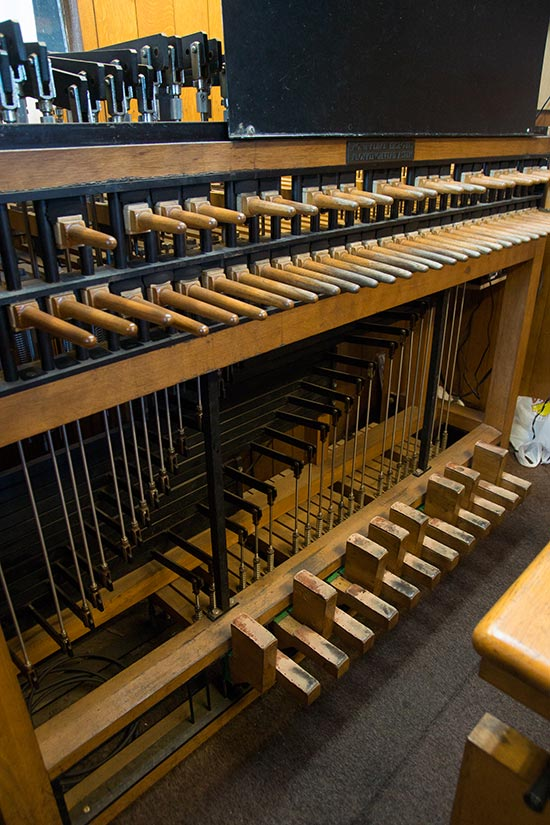
@CyberGene A while ago, during the search for a good way to make a DIY virtual carillon, I came across your Cybrid project. And I think what you did there, would suit my case very well (accept I only need 2 measurement points because a carillon doesn't have dampers). But, since I am software developer (I created my own samplesoftware for the project) and not very much a technican, I am wondering if somebody can help me provide information on how I can start with this project.

I would like to test hammer action first (just like this video I have linked below), but I don't know the best way to start. Maybe somebody can help me? Thank you very much.


CyberGene

AlexanderBunt welcome to the forum 🙂

I think my project (as well as similar DIY projects that are being discussed on this forum) can work for you but it's also possible that you may need much less complexity.

Can you explain what your needs are, do you need velocity detection? If so, then you can reuse the Cybrid and adapt it for only two detection points, which means you can eliminate 1/3 of the trimpots and then simplify the code.


RIP

AlexanderBunt I am wondering if somebody can help me provide information on how I can start with this project.

Welcome. You've come to the right place.

There is a whole community doing just that here. From people nitpicking on the very best option to do the very best possible in the most sophisticated ways, to people doing something "good enough" but very simple, to anything in between.

I suggest you start from https://github.com/davidedelvento/Mybrid (which might be exactly what you need, but it's not done yet!) and you follow all the suggested links back to this forum (which I should have reported here instead of linking that github, but I need to save time to work on the project). You'll be amazed by the big expertise the community has build around this. And just to be clear, I'm only the last wheel of the cart.

Welcome again!


AlexanderBunt

CyberGene Thank you! I'm very exited for this project, so let me tell you someting more.

A carillon has a keyboard (like in the picture below). And each 'key' is directly attached to a hammer that hits the bell if you press the key. Obviously, when you press the key strong, the hammer will hit the bell with a higher velocity, making a louder sound. So yes, I very much need velocity. But indeed, I figured out that I don't need 3, but only 2 different detection points. But, I am very new to all the sensor, pcb, arduino etc. stuff…

Another point is that I only need around 52 inputs, so not the whole 88 like you did with your grand piano. That will simplify a bit too, I think.

RIP

Thank you very much! I have looked at your GitHub, but I have to look a bit further into the details. Thank you for your answer, which might be very useful.


AlexanderBunt

CyberGene

For now, I try to remake your video (linked it below), but I cant't get the code right. Maybe you can help me with this? Like maybe you have that code anywhere, so you can send it me…?


CyberGene

AlexanderBunt I've forgotten almost anything about those early prototypes but from the video I could see the name of the program is "CNY70_Velocity_test_02" and so I found it on my computer.

cny70-velocity-test-02ino.zip
1kB

It uses the Teensy development board which is also Arduino-language compatible.


« Previous Page Next Page »