Joannchr
With a little help from my friends ….

With a little help from my friends ….
Joannchr With a little help from my friends ….
Alright you got it.
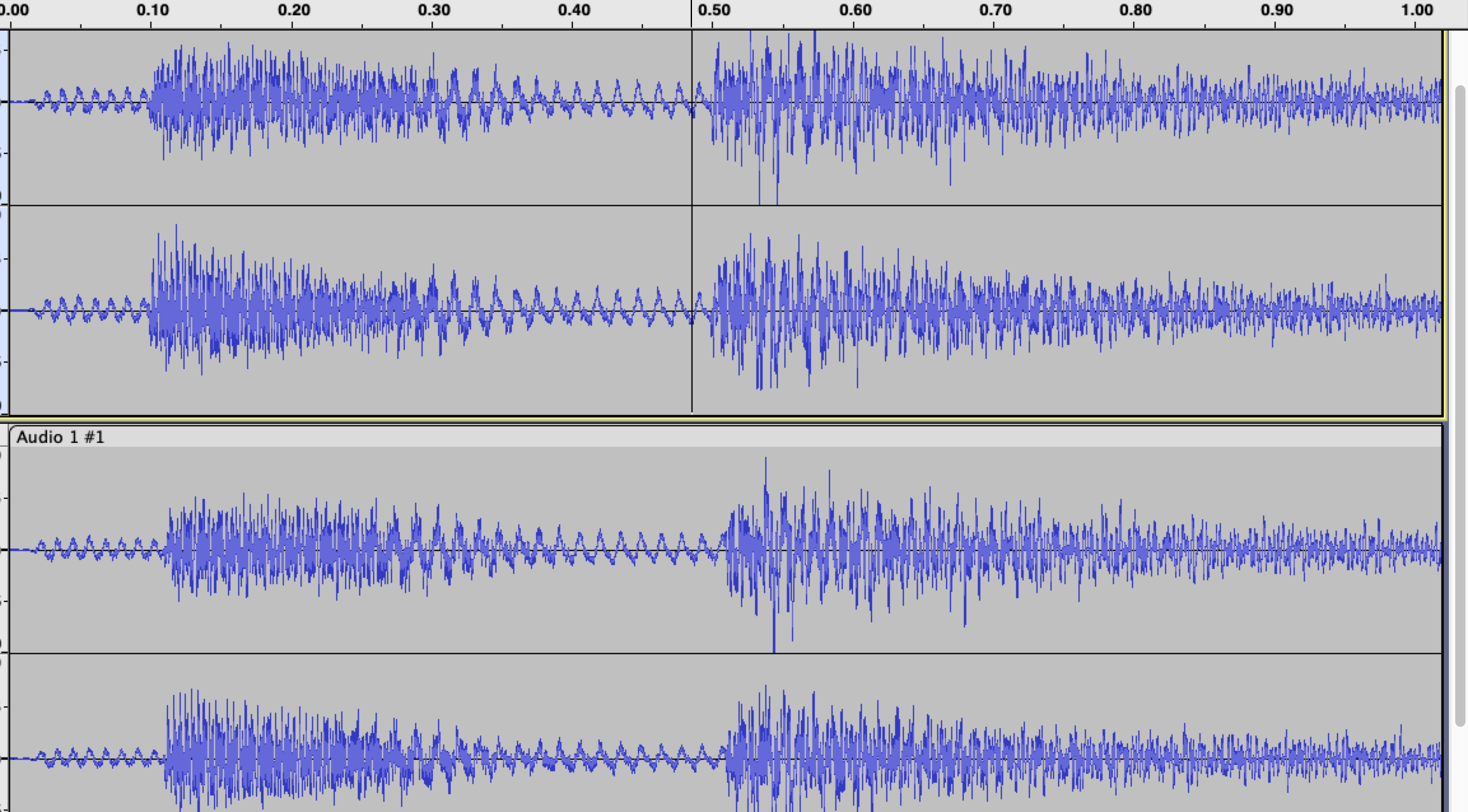
A retired theoretical physicist with the Max Planck Institute for Dynamics and Self-Organization and the University of Göttingen in Germany had too much time on his hands. He was (is) an expert on the physics of synchronization, and a lover of jazz music. So he edited this clip, adding 30ms delay between the piano and the drum. That way it sounded (to him) much more jazzy and swingy. I agree, but my test was not blind, I am a physicist and a geek (in addition to being a lover of jazz music) so I felt my preference could be biased, so I used you guys as guinea pigs.
I think the results are exactly what I thought: people who are lover of jazz and musically very sensitive, like it and may even acoustically aware of what is going on:
HZPiano In any case, based on the better jazzy swing feel alone, "perhaps clip 2".
and
dore_m I feel like 2 is behind the beat a bit, and I prefer it.
Those who are more classically trained (or simply like more that kind of music) don't:
navindra Definitely 1 for me. 2 feels wrong somehow.
And of course many in-between including those for which 30ms is not long enough to notice (might be different when playing a virtual instrument).
I think this research is just a useless curiosity (or at most something to slightly improve things like programmatical MIDI players such as Numula). I would expect and feel that in real playing one would not keep a constant 30ms delay and would instead change that continuously based on feeling as I more lengthily articulated in the discussion https://pianoclack.com/forum/d/765-js-bachs-prelude-in-color-with-pianoteq-8-and-leds/28 (which now that I think about it should have been its own discussion and not a hijack of @navindra recording…)
MHirsch Why my firewall should affect a playback, unless it's trying to establish an inbound connection? 😃
In my experience, firewalls blocks all sort of things (and I mean network-based firewalls, usually deployed in the gateways or routers). If anybody here can download just the audio and repost (or perhaps recreate the whole experiment with another clip), you'll get a chance to give it a listen.
PS: the name of the physicist is Theo Geisel
RIP people who are lover of jazz and musically very sensitive
Hello,
I found this quite interesting and fun 🙂.
I've been through really stressful days, and had no time nor energy for any kind of analyses, close listening or any of that. It was even too much to hook up my hifi for it, so I listened to both clips on my phone speaker, just once each, and went with the gut feeling I got.
I'm happy to find that my gut feeling was 'right', while at the same time, everybody's feeling was 'right'.
It is interesting to be categorized 'musically sensitive' -- deep down I've always known that but am beginning to discover that more consciously just lately. I love jazz (but not all jazz) and have a growing love for classical (but not all classical). I do notice that jazz tends to go straight to my bones more spontaneously, while on the other hand classical music often triggers quite different emotions, which can be rather strong at times as well.
Anyway, a nice thread, reinforcing the special quality of this here li'l Clack community.
Cheers and happy emotional responses,
HZ
so the difference was only in timing?
kawafanboi so the difference was only in timing?
Yes, even though to introduce that delay there might be other artifacts (which I can't hear) leading to some people thinking there was a change e.g. in the tone of the instrument.
Finally got this playing.
TBH, I hear no difference. 😃
I wonder how many people here have played in an ensemble, practiced with metronome often, or recorded to a midi click frequently. After reading the clue in the title, I think I got it pretty quickly. Just wondering if that kind of experience helps heighten the sense of timing.
I'm not sure it's a sense of timing as such. It's also a matter of attaching importance to the timing. For me, for example, the two sound clips are equivalent because their difference is irrelevant; the meaning in the music is unaltered from one clip to the next.
dore_m most definitely. In my case I am trained classically and always practiced with the metronome with ticks aligned with the fastest notes (1/8 or 1/16) of a given passage . That’s why I’m struggling playing jazz which is frustrating as I love it but the swing is against my DNA that’s maybe why I had a sense that there was a slight delta , even though I had to check by looking at the waves to confirm my impression as it’s definitely not easy to spot and I m not certain I would have bet money based on my impression .
I knew there should be some delay, it's in the title after all but it doesn't change it for me. Both sound equivalent as music and as feel. But I think people who listen and play a lot of jazz are naturally more sensitive to the swing.
CyberGene But I think people who listen and play a lot of jazz are naturally more sensitive to the swing.
I'd like to think that I was proficient at jazz, but I'm clearly not - but I guess I fall into the category of listening to jazz a lot. I also played in music groups as a kid, especially drum and bugle corps (which is marching band on steroids).
Also did alot of midi recording to a click, and can see how off I am when quantizing.
I used to play a lot of jazz but after I switched to classical the first thing I noticed was how cr*ppy my rubato was, so for many years now I've been practicing a classical/romantic solo piano feel where tempo and rhythm are not that strict and I guess I've lost that jazz feel... So, I agree with @RIP that this might have to do with classical vs jazz idiom. I wouldn't say classical isn't about having a good sense of rhythm though, maybe depends on the repertoire, I'm personally more about slow and lyrical pieces.
Just to be sure I'm clear, this is what I think:
I don't think there's a good or right here, just an observation.
FWIW my daughter plays in various orchestras and the other day she played in a pretty big one in which I estimated (from the public) her distance from the timpani being about 10m. At 300m/s that's about 30ms. She did say that the timpani was playing a bit late, whereas I (from the audience) thought they were perfectly on time 😃
I voted for both being equally good.
RIP I don't know if this is a reasonable claim or not (within human limits), but I definitely felt and feel the difference in timing between the two samples and #1 remains my preference even after the explanation. #2 gives me the shivers, for whatever reason.
I would listen to some different real life examples of exact / off timing before definitively pronouncing that I prefer one over the other.
I noticed the difference ... but if the stated difference (delay vs. no delay) were not given then I would not be able to tell you what the difference was.
RIP FWIW my daughter plays in various orchestras and the other day she played in a pretty big one in which I estimated (from the public) her distance from the timpani being about 10m. At 300m/s that's about 30ms. She did say that the timpani was playing a bit late, whereas I (from the audience) thought they were perfectly on time
You think that's far, in our drum and bugle corps, we were often 30-35 yards away from the conductor, and 70 yards away from the furthest musician on the field. You have to play in time by looking at the conductor and not listening sometimes.
I liked clip #2 the best as described before.
But listening to various music in real life, I like both approaches depending on the piece, musicians, instruments used, general mood, my mood, and so on.
Sometimes highly exact, tight timing is super powerful and makes a piece come across very, again, powerfully. Which can be utterly enjoyable and engaging.
Some other times a bit of laid back groove can add a fitting atmosphere and rather enjoyable engagement and feelings of joy (or other emotion) in quite another way.
Both are ways of expressing music. Real, powerful music comes from deeply within, and thrives on authentic expression. Whichever way. Music (and all other kinds of art), luckily, isn't an exact science.
Which doesn't mean li'l experiments like this aren't fun and educational!
Cheers and happy discoveries,
HZ
I’ve heard pipe organ players learn to cope with hearing the sound lagging behind their playing too.