Skip to content

VSL Synchron Bösendorfer Imperial

QuasiUnaFantasia

Pete14 I wonder if VSL has some ‘exclusivity’ deal with Bosendorfer (owned by Yamaha of all things); otherwise, why don’t we see a Bosendorfer VST out there from the big guns (Pianoteq, VI Labs, etc)?

Both the Ivory and Galaxy collections include Bösendorfers. I think Modartt may have trouble modelling the effect of the rim in Bösendorfers, because it is not layered like the other makes (as far as I know).

CyberGene I'm not convinced what Pianoteq do with their models is really emulating the pianos they mention

They ought to at least measure and use the various distances that distinguish the different models they simulated. If not, I would consider their alleged diversification dishonest. But I can't see how they would even be able to build their models without these data (unless they were guessing at them, but that would be silly, given how easy it is to take a tape measure and use it).


Frédéric L

QuasiUnaFantasia They ought to at least measure and use the various distances that distinguish the different models they simulated.

Then can do something simple : measure how fast the sound is decayed, partial per partial. Identify multiple phases of the sound (prompt sound and aftersound)*. Identify beats. Then adjust the sound engine parameters to match these measures : no measure of the piano itself (distances, impedance…)

* See https://www.speech.kth.se/music/5_lectures/weinreic/motion.html


Pete14

QuasiUnaFantasia Both the Ivory and Galaxy collections include Bösendorfers

Yes, but these -Ivory and Galaxy- are minor leagues and not the big guns 💪

I’m surprised they still hang in there, but who knows, with the right attitude and hard work they might make into the big leagues some day!🤣

Now, about this rim you talk about, I don’t think the king of VSTs (Pianoteq) would have any problem modeling it.


QuasiUnaFantasia

Pete14 Now, about this rim you talk about, I don’t think the king of VSTs (Pianoteq) would have any problem modeling it.

I don't think so either, as far as the mathematics is concerned, but with a solid rim the entire surface of the piano starts vibrating along with the soundboard (whereas with a laminated construction there should be less vibration of the piano surface), and this increases the amount of calculations considerably, which would probably necessitate beefier CPU's.


Frédéric L

There are EWQL and UVI which have a Bösendorfer too. It is quite common !


Frédéric L

QuasiUnaFantasia and this increases the amount of calculations considerably, which would probably necessitate beefier CPU's.

If they model the sound and not the piano itself, this would just mean different parameters (longer decay by example), but no more computation.


DPPianoPhil

Hey, I'm French (was born there), but at this point have spent more than half my life in the good old US of A. But Moddart is near Toulouse and whenever I am in France (every 3-4 years or so), I tend to not go by there, although of course I have been to the "pink city", a lovely part of the country. While you're there, go to Bordeaux following the Garonne river, stopping as many times as you can among the various wineries! 🍷

Why do I answer in a thread about Pianoteq and Bosendorfer? I don't know: I still don't do VSTs at this point, so please resume your debate: don't mind me. 😅


Ralphiano

QuasiUnaFantasia I don't think so either, as far as the mathematics is concerned, but with a solid rim the entire surface of the piano starts vibrating along with the soundboard (whereas with a laminated construction there should be less vibration of the piano surface), and this increases the amount of calculations considerably, which would probably necessitate beefier CPU's.

I am not so sure that the allegedly "solid" rim of the Bosendorfer is any better than a high quality rim. It is my impression (one that I don't mind having corrected) that the bending of the Bosendorfer "solid" rim is achieved by cutting notches in the rim on the inside of any curve. As the wood is bent, the notches (absence of wood) allow the bending without imposing destructive stretching on the outer surface of the bend. It would be much like automotive drive belts that have notches on the inside surface to allow the belt to bend around the small radius pulleys of the AC compressor, alternator, and other belt driven devices.

It seems that the numerous breaks in the wood fiber created by these notches would substantially change the nature of the wood and its resonance characteristics, perhaps similarly to the resonance damping effect that the glue layers in a laminated soundboard/guitar top do.

I think I got the impression of the notching process from a YouTube video, perhaps from the Bosendorfer company.


QuasiUnaFantasia

Ralphiano I believe the main point here is that the sound propagation is not the same from a solid structure as it is from a laminated one (where there are reflections from each layer boundary). I have personal experience with my familiy's 19th century Hornung & Møller grand, which also has a solid rim, and the outside of this rim vibrates intensely, when the piano is being played. Therefore you could not model the sound propagation correctly if you disregarded the rim. But I suspect (without having any concrete evidence) that Modartt has always disregarded it.


Ralphiano

QuasiUnaFantasia I have personal experience with my familiy's 19th century Hornung & Møller grand, which also has a solid rim, and the outside of this rim vibrates intensely, when the piano is being played.

To satisfy my curiosity, have you ever investigated how the bending was accomplished on your family's Hornung & Moller? I'm very curious. I once built my own mandolin, which required some bending. However, those woods were only about 1/8 of an inch thick, and I do not think those techniques (steam softening of the resins) would work on wood as thick as a piano rim. So, I'm really curious how wood whose thickness might be an inch or more, gets bent without suffering destruction.


QuasiUnaFantasia

Ralphiano I'll have to check next time I get the chance (fairly soon).


QuasiUnaFantasia

Ralphiano Okay, I've checked now, and it was quite a surprise, because the Hornung & Møller is different from both the modern laminated ones, and the Bösendorfer style.

The rim is in fact layered, but the layers are stacked on top of one another, each layer being a couple of inches thick. The curve in the rim seems to be sawed, so basically a number of similar pieces of wood are cut to fit the curved shape, and then they are stacked onto each other. No bending of wood necessary!

Moreover, the rim is something like 4 inches thick!

By the way, the Hornung & Møller grands have a very distinct sound. To my ears they are unique, with all other brands sounding quite similar to one another.


Ralphiano

QuasiUnaFantasia The rim is in fact layered, but the layers are stacked on top of one another, each layer being a couple of inches thick. The curve in the rim seems to be sawed, so basically a number of similar pieces of wood are cut to fit the curved shape, and then they are stacked onto each other. No bending of wood necessary!

How interesting! This would have been the least expected possible answer!

The construction technique you described would result in a rim that is completely, or nearly completely, tension free. There would be no forces trying to straighten the bends back to the wood's natural state.

This might explain the unique sound. I remember a demonstration of how tension in the wood forming the sound transducer increases amplitude as compared to a tension free sound transducer. I cannot remember if the demonstration tried to explain tonal differences. But, its overall point was that when a soundboard is built with tension tending to oppose the force of the strings acting upon it, it produces much more sound. Thus, the arched design of many string instrument tops, including the piano.

Although the piano rim is not acted upon directly by the strings, it's unification with the soundboard where they meet would make it a part of the overall transducer. And, perhaps the Hornung & Moller differs from the absence of sound contribution from the rim that other pianos exhibit.


RIP

QuasiUnaFantasia By the way, the Hornung & Møller grands have a very distinct sound. To my ears they are unique, with all other brands sounding quite similar to one another.

Recording needed. Just your phone suffices, as I mentioned in the Microphone thread


QuasiUnaFantasia

RIP Recording needed.

I suppose so, but the piano is currently very out of tune, so I don't really like to record it at present. I'll make some recordings at a later point, when it has been tuned (and regulated).


jdg78

Resurrecting this thread as I recently purchased the VSL Synchron Bosendorfer Imperial, and wanted to give my impressions.

This is actually my first experience with any of the VSL instruments. I'd been curious about them for quite a while, but kept resisting taking the plunge for 2 main reasons: 1) the high cost in comparison with other libraries, and 2) the annoying dongle requirement.

Well, they recently did away w/ the dongle requirement, the dollar happens to be at its strongest vs. the euro in years, and they've been running a sale for the past several weeks, so I took this all as a sign that it was finally time to give in to the temptation.

I was fully prepared to return it if it didn't live up to expectations or didn't offer a meaningful improvement in the overall playing experience vs. other VST's I own or have tried (Garritan, Noire, Ravenscroft, Grandeur, Maverick Walker D, Pianoteq), but I'm happy to say that I certainly won't be returning this - it's absolutely stunning. If anything, it exceeds whatever expectations I'd had coming in by a pretty wide margin.

First of all, the playability is absolutely superb - the best I've ever experienced from any VST, and easily besting my previous reference in this department (Garritan). It responds to anything you throw at it without breaking a sweat, and picks up small nuances and changes in touch far more effectively and realistically than any other digital instrument I've tried.

The quality of the samples is very impressive - extremely clear, clean and deep. One of the reasons I was attracted to the Bosendorfer Imperial was because of its particular sound profile which offers a more defined, sculpted sound in comparison to, say, a Steinway, which tends to a more blended, rich sound. That quality is very faithfully captured in the VSL rendering - even when playing thick chords, the overall sound remains amazingly clear and defined while still satisfyingly full.

I would not exactly call it an intimate experience - you really feel like you are in front of a large, powerful, concert instrument, so if you are trying to recreate the sense of playing in small jazz club late at night, this probably isn't going to do it for you. However, it is capable of an impressive degree of warmth and delicacy if you dial in the settings.

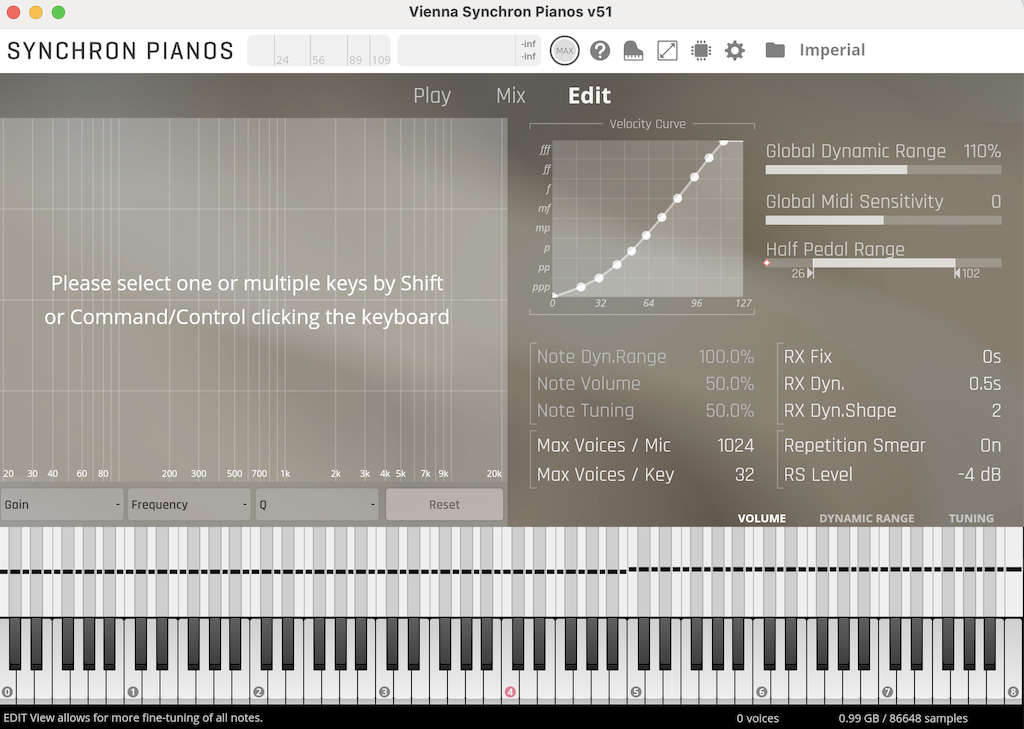
Speaking of settings, as far as I'm concerned the Synchron piano player is a model of excellent UI design, usability and functionality compared to most other systems (ahem, Kontakt). It's very well laid out, intuitive to use and offers an impressive array of useful parameters for customizing the sound and midi controls. Kontakt actually offers a similar level of customization features, however its usability is atrocious, and it looks like it was designed to run on Microsoft Windows circa 1996. It literally took me 6 months to discover that you could adjust the velocity curve. With the Synchron player, I had more or less figured out how to operate everything I needed after just a few hours of playing around. Extra bonus points for being able to expand the window up to 200% so that it fits nicely in my 27"monitor.

So all in all, I couldn't be happier with this. I think the only downside is that I fear I'm eventually going to have to try out all the VSL Synchron pianos, and probably upgrade to the full version of the Imperial at some point, which could be very hard on my wallet. 😭

Seriously, though - if I was VSL I would strongly consider also offering a "Light" version of all their Synchron pianos, with just a single close microphone, and price it around $150-200 so that it competes directly with the likes of Garritan, Ravenscroft, Noire, NI, etc. Then offer the standard and full versions at the existing price levels.

I know they have a generous return policy, but there is something of a psychological barrier involved with forking over $300-$500 in comparison to $150, especially when no other competitor is really operating in this price category. I have a feeling that they would be able to more easily grab a segment of curious but hesitant customers who might then be convinced to upgrade to the standard or full versions. I certainly would have tried it out a lot sooner if this was an option. Anyway, just my $0.02.


David B

jdg78 Resurrecting this thread as I recently purchased the VSL Synchron Bosendorfer Imperial, and wanted to give my impressions.

Cool! Thanks for sharing. Having owned all of the Synchron Pianos myself, the BI is my favorite of the bunch.

jdg78 I would not exactly call it an intimate experience - you really feel like you are in front of a large, powerful, concert instrument, so if you are trying to recreate the sense of playing in small jazz club late at night, this probably isn't going to do it for you. However, it is capable of an impressive degree of warmth and delicacy if you dial in the settings.

You could get close to that late night jazz club sound by adjusting the velocity curve to limit the higher volumes. Start with one of the intimate presets and then bring your velocity curve down and you'll get that smaller grand sound.

jdg78 Speaking of settings, as far as I'm concerned the Synchron piano player is a model of excellent UI design,

Agreed! It was lacking an appropriate velocity curve editor, but once that was resolved the Synchron Piano Player now stands head and shoulders above anything else I've used.

jdg78 So all in all, I couldn't be happier with this. I think the only downside is that I fear I'm eventually going to have to try out all the VSL Synchron pianos, and probably upgrade to the full version of the Imperial at some point,

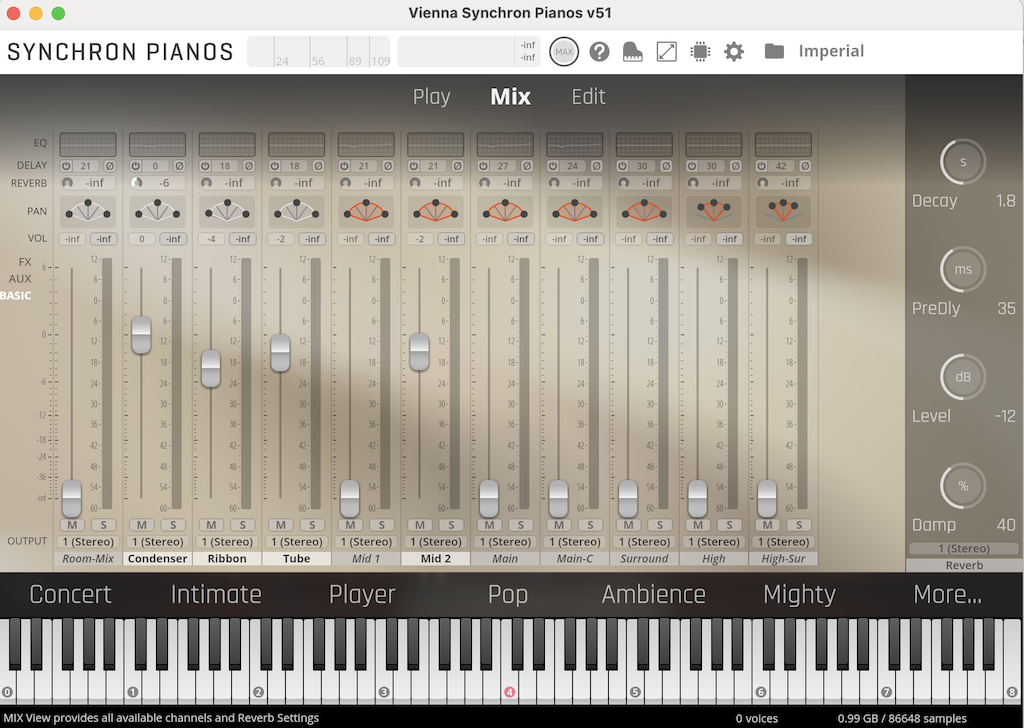
Every preset I've ever used has some variation of the full version in it. I don't think I could be satisfied with the just standard version. Here is my most recent preset.

Congrats on the purchase and enjoy. Don't be shy about sharing a recording once you get the sound you like dialed in. I love trying different presets.

God Bless,
David


jdg78

David B

Thanks for sharing your settings. For the time being, I’m happy enough with the sound I’m getting from the standard version, but I could see myself upgrading to the full version at some point in the future.

Actually, I’m really only interested in the ribbon and tube mics from the full version, not so much the other ones. It would be nice if VSL sold additional mic positions a la carte, the way Embertone does with the Walker!


David B

jdg78 The tube mic brings out the bass more and the ribbon adds some nice diffusion to the attack without the added reverb the other room mics produce.

God Bless,
David


David B

Here is a short recording I did today with my current presets. This is such a beautiful warm sounding piano. Playability is the best compared to my other VSTs. The settings for this excerpt are the same as in the screenshots above.

God Bless,
David


« Previous Page Next Page »