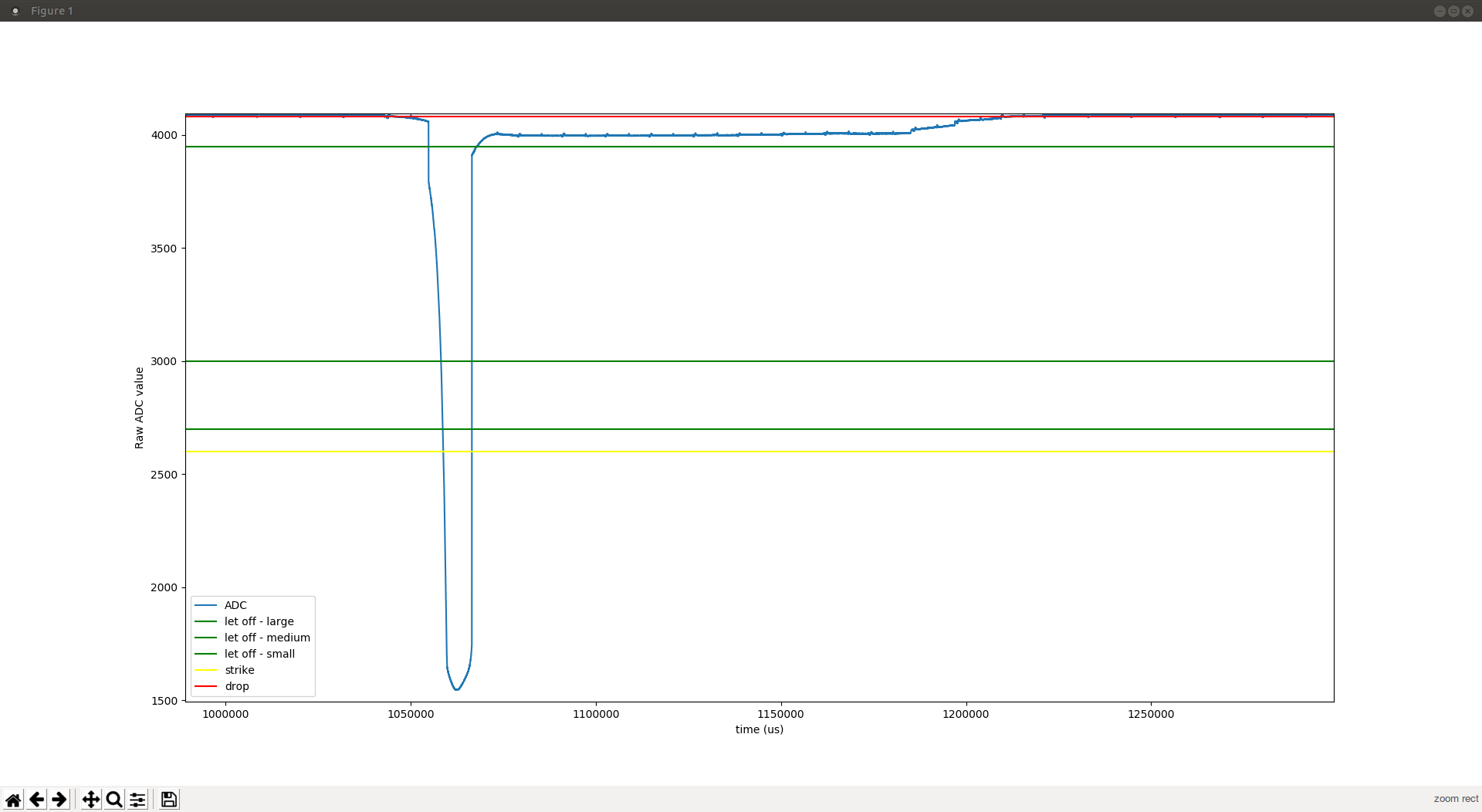
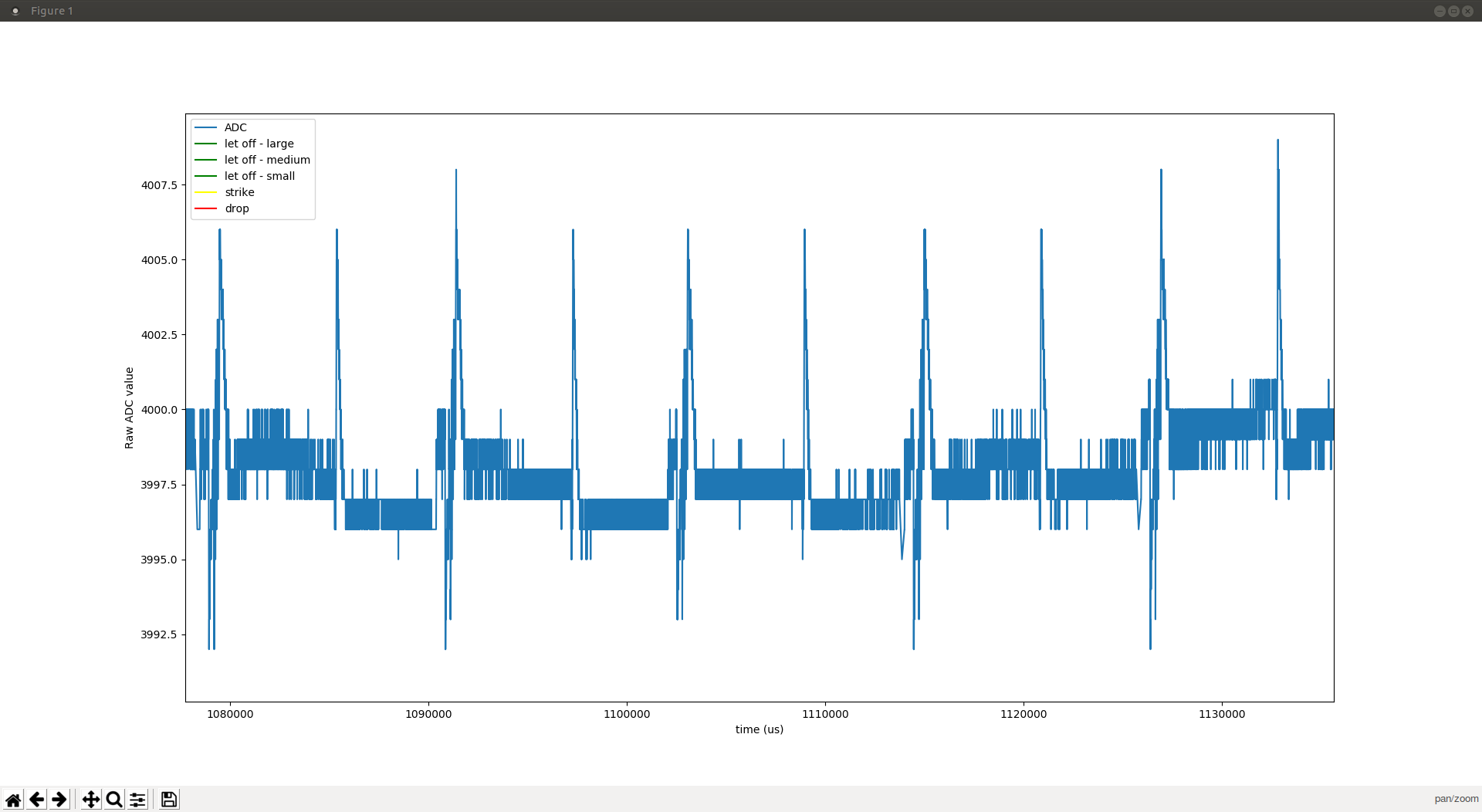
JayKominek Yeah that's a pretty odd bit of noise. One would expect 30, 60, or 120Hz noise from lights or other AC sources in one's home.
Yes! The only reason I mentioned AC lights is that I eyeballed the frequency, so it could have been 120Hz if I did it mental math wrong.
JayKominek Going wildly out on a limb, do you maybe write to the SD card at some multiple of 160Hz?
Not explicitly. The SD-card-writing is done via SPI by a library which I just peeked a bit under the hood, but I did not examine it very closely. I know that it does use IRQs.
I wanted to use IRQ for the ADC, but instead I am just sampling as fast as I can in a loop, so no particular frequency of mine (but the SPI has its own, which I set but is not fully honored: it goes somewhat slower)
JayKominek If you, hypothetically packed the two 12 bit samples into 3 bytes
That's almost what I do: 2 samples and 12 bit of elapsed time (with overflow, which I then unroll while doing data analysis). As linked in the README of the linked repo, the code for this 3-byte stuff is here and in the same repo is the library in use.
At this point I consider myself satisfied, and I'll go back to the MIDI velocity estimation based on this cleaner data. In that regard, I think that your own discussion here and @xooorx 's colevity here are already (close to) the back-of-the-envelope SG that I was asking.
In other words: if the scanning frequency is (say) a fast but comfortable 10kHz, i.e. the interval between samples is 0.1ms, then at fff the hammers move less than 1mm between samples. If we can measure the hammer position with enough spatial resolution (say 1% just to make that ballpark of 1 MIDI velocity out of a value of about 100 -- yes I know that logarithmically it will be a bit less) then we are ok in term of resolution. Eyeballing your distance-to-ADC plot, if one ignores that "dip" at close distances (which is horrible for this purpose), it feels like we do have the resolution.
The question remains that I am not sure SG will behave correctly for such a MIDI velocity computation at the upper end of the dynamics, with the approach of simply accumulating and utilizing the last ~ 23 values (as your code was doing last time I looked). If that fff speed was constant, 23 values would be about 23mm and that is about half the travel of the hammer. Obviously the speed is far from constant if such a long range, so the distance will be much less -- but the important part will be the last couple of samples only. Would a fixed-window SG filter with 23 values work as we want in these conditions? I am still not sure, but at least that's progress compared to my understanding of last week. I'll think more about it, and hopefully @xooorx and/or @luns will chime in with additional insights (and of course you, Jay, might have ones too).