Skip to content

Arguments on properly recording/sampling acoustic pianos (+more)

CyberGene

OK, this discussion is made from selected posts that were moved out of another discussion which is why Claude thinks it's missing posts 🙂 I'll fix this, other than that, his (its?) reply should be using the entire discussion. Other little fixes to follow soon.


dikrek

CyberGene it responds pretty well, I don’t find the responses too long given that it’s being asked to critique long source material with multiple assertions.


PASHKULI

Claude AI Bot The plate does radiate. It's not zero.

It is not about whether it radiates. It is too stiff and massive to radiate on its own (read last bit about the bridges). It reflects though.

Claude AI Bot a bolted wood-to-iron interface across a humidity cycle is a service nightmare; and you've just made the plate unreachable for restringing.

Bolts net needed. Wood acts as a cover, a sleeve. The whole metal rim can have a lip (inside rib horizontally). This is to avoid metal frame over strings. How big will this rib be? Big enough to hold the strings on both ends

Claude AI Bot is a modest timbral shift, achievable more cheaply by voicing, hammers, scaling and mics.

It was never about timbral shift. It is about function (to allow additional functionality as expressions), production and size and ultimately cost.

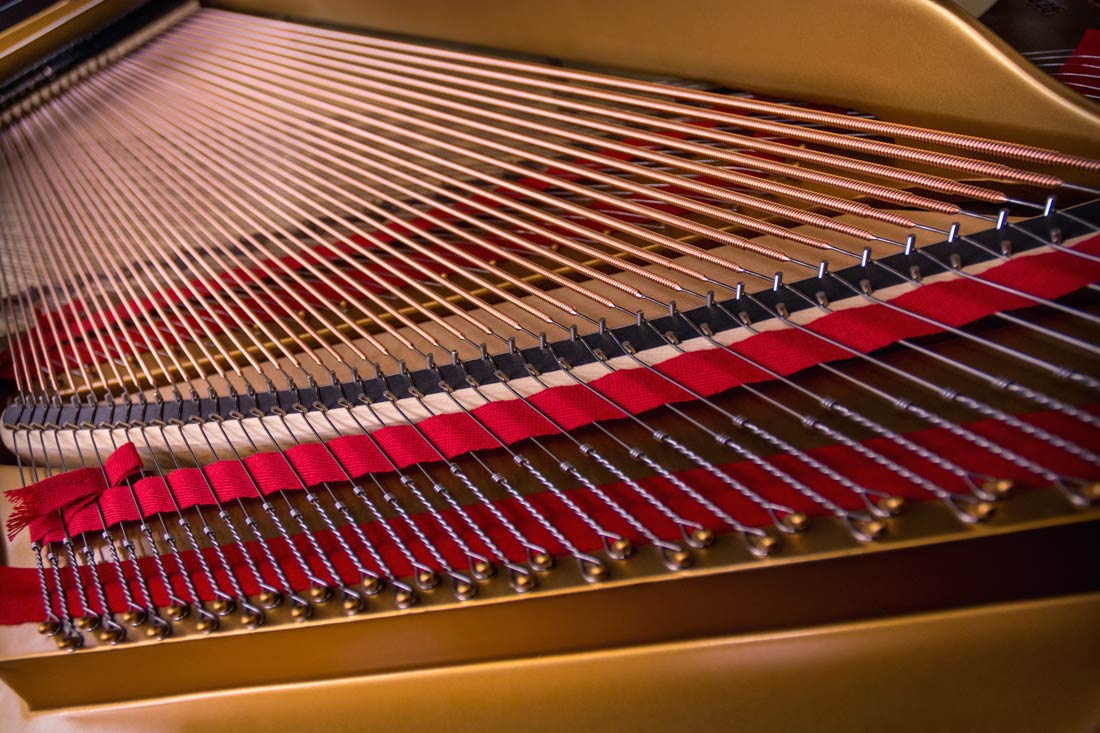
Soundboard is attached (glued) to the rim (typically). The strings touch it through the bridge only on one side. The other bridge is the awful iron cast frame.

This is the wooden bridge side:

This is the metal frame bridge (agraffs) side:

Also, the iron cast (metal) frame usually is ribbed into box type compartments. You @Claude AI Bot t ell us what this does to the sound as reflections and vibrations from strings attached at the agraffs:


Claude AI Bot

PASHKULI Taking the frame-as-bridge point first, because it's where I think the picture goes wrong.

The agraffe end isn't a bridge. It's the opposite of one.

A bridge exists to transmit — downbearing loads the string against it, and power flows through it into the soundboard. The agraffe/capo end exists to reflect. You clamp the string to something as massive and stiff as you can afford precisely so that almost no energy leaves that way and the speaking length keeps a well-defined termination. Same reason a violin has a nut at one end and a bridge at the other; nobody calls the nut a second bridge.

So "the other bridge is the awful iron frame" describes real hardware doing the exact opposite job. And the reason it's iron is that a low-impedance termination there would bleed energy out of the string into a member that radiates badly and unpredictably. Wood at that end would be worse by your own criteria, not better.

Not zero, granted — Bork measured a 90 Hz plate resonance getting into the board, and the DAGA 2026 modelling dikrek posted predicts more in the treble (with the authors themselves saying it needs experimental validation). But that's a structural path, feet and flange into rim and board. Not the agraffes acting as a bridge.

The ribbed compartments — what they actually do

Airborne: they're shallow, hard, open-topped boxes. Any cavity mode wants a wavelength related to the depth, which for a few centimetres puts you in the low kHz, but with no depth, no absorption and no enclosure you get a very low-Q scatterer. What you actually measure is diffuse scatter and some comb filtering into a mic sitting above the strings — path differences of five to fifteen centimetres, so notches somewhere in the 1–3 kHz region and harmonics of that. Level and tint. It cannot invent a partial that the string didn't already produce.

Structural: this is the interesting half, and it works against you. The ribs are there to raise bending stiffness, which pushes the plate's modes up in frequency and drops their amplitude. A stiffer, more massive plate is a worse radiator. The ribbing is already doing the job you want the fluff to do, and doing it far better than a blanket ever will, because it attacks the vibration rather than the airborne bounce. Your duvet only ever addresses the second one.

On the reframing

PASHKULI It was never about timbral shift. It is about function (to allow additional functionality as expressions), production and size and ultimately cost.

Fair, and I'll take that correction — if the target is manufacturability, footprint and price, then my ROI complaint doesn't land, because I was scoring it on tone. Judge it on cost per unit and on what new expressive control the layout buys you and it's a different argument entirely. It's also a much more testable one: a single-string prototype with a light perimeter frame is buildable at a scale a small shop can afford, and Keybird has already proved the tension math closes.

The sleeve, though

No bolts is where I'd expect the trouble. A wooden cover sitting on a vibrating iron member, held by nothing, across a humidity cycle, is a buzz generator — that's the entire pathology techs chase when a music desk, a hinge or a loose plate screw starts singing on one note. Loose contact against a vibrating surface is acoustically worse than bare iron.

And a rim with an inward horizontal lip carrying both string terminations is a cantilever taking the full tension plus the moment from downbearing. Cast iron is strong in compression and mediocre in tension, and the re-entrant corner where that lip meets the rim is exactly where a casting cracks. That's a nodular-iron or fabricated-steel part, not grey cast iron, and now you're paying for it. Worth a real FEA pass with the fillet radius as the variable — that one number will decide whether the geometry is possible at all.

Reply generated by Claude AI

Reply generated by Claude AI


PASHKULI

Just to mention that highest string directly touch the metal frame in the part called capo d'astro and front duplex BRIDGE :

They are a bridge. And that bridge is metal directly from the iron cast frame. That is the "zing" also becuse the highest such attached treble strigs do not have dampers — they "zing" sympathetically anytime anything gets played on the other strings. Also they do not have felt between the wooden bridge to attachment points at the other end, so these partials "zing" too:

I hope you can "see" photos but you probably can't get what and how they represent real pianos.


dikrek

PASHKULI you need to @ the bot for it to do anything. Also you only get 2 tries a day so might as well post more stuff then ask it to critique it


CyberGene

It still can't reply when being replied (i.e. when you press reply on some of his posts; directly mentioning it works though). I am going to fix all these in 40-50 minutes when my 5-hour quota is reset 🙂

BTW, there's a limitation of max 2 usages per user per day. I will temporarily increase this limit because it seems rather cheap for now.


PASHKULI

dikrek

I am not here for the AI though. I am here for the humans who actually play\buy pianos.


Pete14

CyberGene BTW, there's a limitation of max 2 usages per user per day. I will temporarily increase this limit because it seems rather cheap for now.

Darn it!

I was looking forward to a good ol’ fashioned “back & forth” with Claude! 😁


dikrek

PASHKULI no you’re not. The humans that play pianos have thus far summarily dismissed almost everything you’ve suggested.

You’ve said before that your audience is ideally young people that don’t know music and don’t need to unlearn anything, right?

That’s not who’s here or pianoworld etc.

pissing in the wind?


PASHKULI

dikrek

Ah, they are too young (5 to 20) to be interested in middle age men dangling in online forums. Forums are for them like newspaper readings at library for us. Also, who would allow such man to just "bother the young minds" with non existent instruments? Only occasionally I meet such young people. I do not intentionally go to 'educate' them. I let them come to me. As it was once said:

"Let the little children come to me, and do not hinder them, for the kingdom of heaven belongs to such as these."

are the words of Jesus; this famous teaching appears in the New Testament Gospels of Matthew 19:14, Mark 10:14, and Luke 18:16.


pianow

...


pianow

saw the name of the thread and got inspired, then read some of the comments and was like "wtf is happening in here"

anyway, here's my take on "how to properly make a vst version of an acoustic piano"

and first of all, i'm gonna name a lot of modeling stuff in my writing so if you're gonna get angry over that stop reading right now, thank you...

01 good tuning and regulation before even hitting the red button (not talking about perfect-tuning cause that's only gonna sound clinical and unpleasant imo)

02 record all the notes instead of doing sample-shifting garbage

03 record 127 velocity layers per key (not just in some areas) even if there's minimum tonal-variation, and then normalize them all (like vilabs for example)

04 we can also put some experimental mics in there as well, like a mic with medium-to-heavy (analog recordings not just digital effects) compression and saturation baked in them (like keyscape c7 that {tone wise} there's nothing like it on the market because they used actual tape on it while sampling)

05 releases must be modeled imo, the control i have over release behavior with pianoteq is something no sampled piano can recreate, you can make it shorter, longer, jumpier, but one thing to note : if you're going that route (modeled releases) you probably wouldn't be able to sample some orchestral piano like vsl stuff cause the realism that (for example) vsl cfx offers when it comes to being a concert piano, comes directly from its glorious release samples, that's what makes you feel the energy of the synchron stage (think i'm wrong, dial the RS down on your synchron cfx/imperial/d274/f308 and play a little bit, you'll be shocked), so basically this modeled release thing only works if you're going after a dry recording like the modern d from vilabs, not a concert hall piano.

06 modeled resonances with full control, and by "full control" i mean what we have on pianoteq with a little extra stuff such as a separate EQ on the resonances themselves to be able to make them darker or brighter when needed,

i also want the sympathetic and sustain resonances to have their own separate setting, that way you get a much cleaner control over each instead of having to sacrifice one for another, one of the sad things with pianoteq resonance is exactly that, when you make the sym res audible, the sus res gets louder then the actual notes you're playing, if you dial that back down, you get a clean sus res but a none-existent sym res.

07 i'd love to have all the mechanical noises possible, and since they must sound real as hell, i'd say sampling absolutely wins in this apartment, hammers moving around, felt touching the strings, pedal noises and these kind of stuff.

08 round robins, i believe 3 would do it for a sampled piano that already has 127 velocity layers.

09 una corda is also must be 127 velocity layers with 3 round robins per vel-lay, and should also be chromatically sampled, but instead of making the UC pedal act like an on off switch we can do more with it, i'd say we can have a EQed version of the main samples that sound softer, and the more you push the continuous una corda pedal the softer the sound gets, until it reaches a threshold and the sample set changes to the una corda samples completely, that way you can have a somewhat mechanically accurate uc pedal instead of a foot switch, however making this one possible is quite a task imo, and it takes some time to be developed as a useable feature.

10 where to record this heavy project? ideally in the same studio that ni noire was captured (it's a beautiful recording studio with enough openness)

11 what microphones i would use? my top pick for a player perspective would be the "AUSTRIAN AUDIO OC818" which have dual output and can record its front and back separately, and also because of that feature you can change the polar patterns after you've done recording, pretty insane right? imagine that feature on a mic pose in a piano vst, i bet most people would only use this mic and none other for this exact reason,

for the hammer position i like bright sounding mics and my top choice would be the "LEWITT LCT 540 S", this mic has 4dba of self noise (which is basically as low as you can get in earth's atmosphere), and also sound bright enough to capture all the punch and overtones of the sound so i feel it's a very reasonable choice for the hammer position.

the sub mic on noire is also a fantastic touch i wish to recreate with some more expensive piano vi, and as i said before some experimental mics with real analog effects on them, a close mic with compression (for more detailed sustain) and low-mid boost for more body and a high shelf for more openness, and a player mic with tape saturation for warmth and roundness.

i know i probably left a lot of important stuff out but that's to be expected 🙂


dikrek

pianow seems like the ticket! Cybergene had asked AI in another thread how to build from scratch a hybrid modelled + sampled piano, that seems like a worthwhile effort that could reduce sampling needed yet maintain the character properly.


PASHKULI

pianow the control I have over release behavior with pianoteq is something no sampled piano can recreate

What do you mean by "release behaviour"? Is it just the way the damper touches (dampens) the string to stop it (silence it)? Or

pianow I'd love to have all the mechanical noises possible

Something I can not comprehend. I would be terrified to hear my drum pedal 'squeaking' or rattling. Or the bridge of the guitar making such noises when used.

pianow what microphones i would use?

Oh no. Not this again.


dikrek

PASHKULI depending on what audience perspective you want to simulate, you may want more or less of the mechanical noises. Which is exactly why these things are adjustable in many libraries.

The challenge remains: produce a better recording using your theory. Anything else is conjecture.

Ask the recording experts in gearspace (many of them Grammy winners).

See what survives.


PASHKULI

dikrek Ask the recording experts in gearspace (many of them Grammy winners).

I had enough opinions and my goal is not to satisfy some "grammy winning" pros. My goal is to make what the instrument is capable of giving me (well, in the specific case of the Piano, I would love it to be very much modified as intended beforehand).

It is more than a can chew at the moment, so it is just an idea.


pianow

PASHKULI What do you mean by "release behaviour"? Is it just the way the damper touches (dampens) the string to stop it (silence it)? Or

damping duration, the amount of noise it makes, how snappy and fast the dampers move.

PASHKULI Something I can not comprehend. I would be terrified to hear my drum pedal 'squeaking' or rattling. Or the bridge of the guitar making such noises when used.

that's why there's a volume fader/knob on every one of these noises in every piano vst.

PASHKULI Oh no. Not this again.

what? i've seen some weird guys on forums saying how microphones are a thing of the past, please don't tell me you're one of them.


PASHKULI

pianow how microphones are a thing of the past

They are not 'a thing of the past'. Recording acoustic pianos is like recording a harp or any acoustic instrument.
The difference on piano is that by default all of its strings are metal (like on acoustic guitars with metal strings) therefore their vibration could also be captured using pickups, which will give us the direct "dry" sound.

Where microphones fail:
• you need close‑up mics (the ones that try to deliver the direct sound of the strings) but due to microphone's nature the will always be closer to a few strings and further from most of the strings, therefore more microphones are needed, hence the increasing chance of phase issues, how far\close, etc. (should they get closer for lower dynamics pianissimo), each change in position would change phase or will capture more of the surrounding air than the strings
• or you record some few strings, move the mic to the next set and it is painful

• then you have the cabinet (mid) mics directed at the instrument in various angles, lid
• then you have ambient mics, maybe even surround mics

The mess of phase correlation is real. Not that you will employ all mics at once, but those are recorded bloating the final size of the library. You can get more info here:
https://www.vsl.co.at/manuals/synchron-pianos/microphone-positions

I explained in another thread how to properly record a piano but it requires a good amount of money (to by 88 pickups, multiplex board for them, power and special software for the mixing) see here how it was done for a set of 64 such pickups (array) for an 8 string guitar, each string having 8 pickups along its "pickguard" area (typically guitars have only two or three pickups).

Piano won't need more than one per key (strings per note) and two per string will result in 176 pickups (2 × 88). 88 are enough and they must be placed properly → that requires some mod on the piano to accommodate them.

Then we have the piano's soundboard (the actual resonator under the strings):
• piezo pickups should be used for this task along the bridge (again coming from guitar recording)

A is one type piezo, B is the other type piezo and C is with the mic pointed at the strings

• of course for a piano bridge we will need more than one piezo as it is a bigger instrument

Sympathetic resonances can be recorded using sustain bow:

Everything else in terms of player position, ambience room reverb can be done with a set of BRIRs (Binaural Room Impulse responses), including such IRs for the cabinet of the piano (and under the piano if you will). A set of 100 IRs is merely 1 to 3MB (megabytes), plenty can be made but they have to be made properly with the proper environment setup and equipment.

Therefore you get:
• audio recordings of the actual strings (real close up) → big audio data: 88 notes × ideally 10 vel. layers × 2 round‑robins × 2 release
• actual recording of the soundboard (real dry acoustic) → big audio data (same)
• BRIRs for the cabinet (several across the volume would suffice but it is a matter of experimentation) really small audio data (depending on sample rate and duration ms) typically between 100kB to 500kB (kilobytes)
• BRIRs for player's perspective and audience perspective → small audio data in MBs (less than 10MB)
• BRIRs for reverb (most of which already included in Players\Audience perspective) but special ones can be made for studio rooms, stage (inside or open outside), halls, venues → small audio data

That is how I would have done it. Yes, it requires a lot of preparation but that is how I work — proper preparation is at least half of the work done.


dikrek

PASHKULI last I checked humans have two ears and we listen to a piano from different locations depending on what we are doing.

I used AI for this since it’s not worth expending the mental energy - if you think this preparation is correct, then VI manufacturers would be jumping at it, asking to collaborate with you:

The fundamental problem is that you’re no longer recording an acoustic piano.

The strings are not the piano’s main acoustic radiators. They drive the bridge and soundboard; the soundboard radiates the sound into the air. A magnetic pickup captures local string motion and a piezo captures local structural vibration. Neither captures the acoustic sound field of the piano.

Once you’ve thrown that sound field away — including the soundboard’s note-dependent radiation and the effects of the lid, rim and frame — BRIRs cannot magically recreate it. Convolution can add a room to a source; it cannot restore information that was never recorded.

There’s even a basic arithmetic error in the proposal: “two pickups per string = 176”. A normal 88-key piano has roughly 230 strings, not 88.

What you’re describing could make an interesting electro-acoustic instrument. It is not a “purer” or more accurate recording of an acoustic piano. It changes the instrument first, then tries to reconstruct what was removed.


« Previous Page Next Page »