Skip to content

My Desert Island Piano VST - VI Labs Modern D

Jane

Jane
As an update to my Modern D pedal travails...

@David Lai was kind enough to look at the MIDI from my little experiment where the piano sounds weren't clearing when I let the pedal up.

He noticed some weird pedal MIDI values.

So I've tried two experiments.
The Yamaha N3 has a self-test. In that mode, the una corda pedal goes rather linearly from something like 10 to 240 as it's pressed and released.
The sustain pedal, on the other hand, goes from about 14 to 255, then back to 40, then up to 240 as it's pressed. And the same as it's released. Double bounce oops!

The second test - Pianoteq's interface shows the pedals, and I can actually see the sustain pedal bounce a couple of times in Pianoteq as I'm pressing it smoothly once from fully up to fully depressed.

So I guess I can't blame VI Labs for that, in spite of the fact that other VST libraries don't seem to be bothered.
I've downloaded the service manual for the N3 and it says in BOLD type that the "rotary volume installed to the pedal lever unit needs adjustment at the factory and it should not be replaced. Do not touch the rotary volume when removing the pedal lever unit." Ouch. By "rotary volume" I assume they mean a potentiometer that tells the computer how far the pedal is pushed.

Yamaha had a tech from 100 miles away come to fix a different problem with this unit about 6 years ago. I guess the next step is to see whether I can get a replacement pre-calibrated pedal assembly from Yamaha or else see whether that tech has access to parts.

Anyone have other advice?


David B

Jane I guess the next step is to see whether I can get a replacement pre-calibrated pedal assembly from Yamaha or else see whether that tech has access to parts.

Anyone have other advice?

Since it's out of warranty I'd do whatever I could to try and fix/adjust it myself if that's even possible. It sounds like the pedal behavior is not normal even if other VSTs are not bothered by it. I wonder why UVI/Modern D is sensitive to it while the others are not? Hope you can get it solved because the Modern D is worth playing.

God Bless,
David


HZPiano

Jane

As @David B says, I'd be inclined to DIY too.

It's quite probable that you're guessing right that it is a potentiometer and those aren't exactly rocket science, so to speak. Of course this is not a 100% certainty.

I'd start by unplugging/de-soldering the leads to that pedal and to measure (with an Ohm-meter/multi-meter) the behavior of that potentiometer first -- without touching any of the mechanics yet -- and see what can be found from that.

Of course you'd need the nerve and a bit of handiness to start such an exploration.

In any case do carefully consider every step along the way.

Cheers and.. a happy outcome,

HZ


Jose EB5AGV

Jane get a can of DeoxIt D5. Open the pedal unit and spray a tiny amount (i.e. there is no need to flood it on cleaner) on the offending pot. Exercise the pedal several times and recheck. If there is no improvement, a replacement pot is advised.

If you are in doubt on where to apply the cleaner, share some pictures of the pedals mechanism and I can tell you.


dore_m

I agree with Jose. Had similar noisy pedal problems myself. Same fix.


Jane

Thanks, Jose. The only cleaner I have on hand is an ancient can from Radio Shack, so I ordered D5 and should have it by Friday.

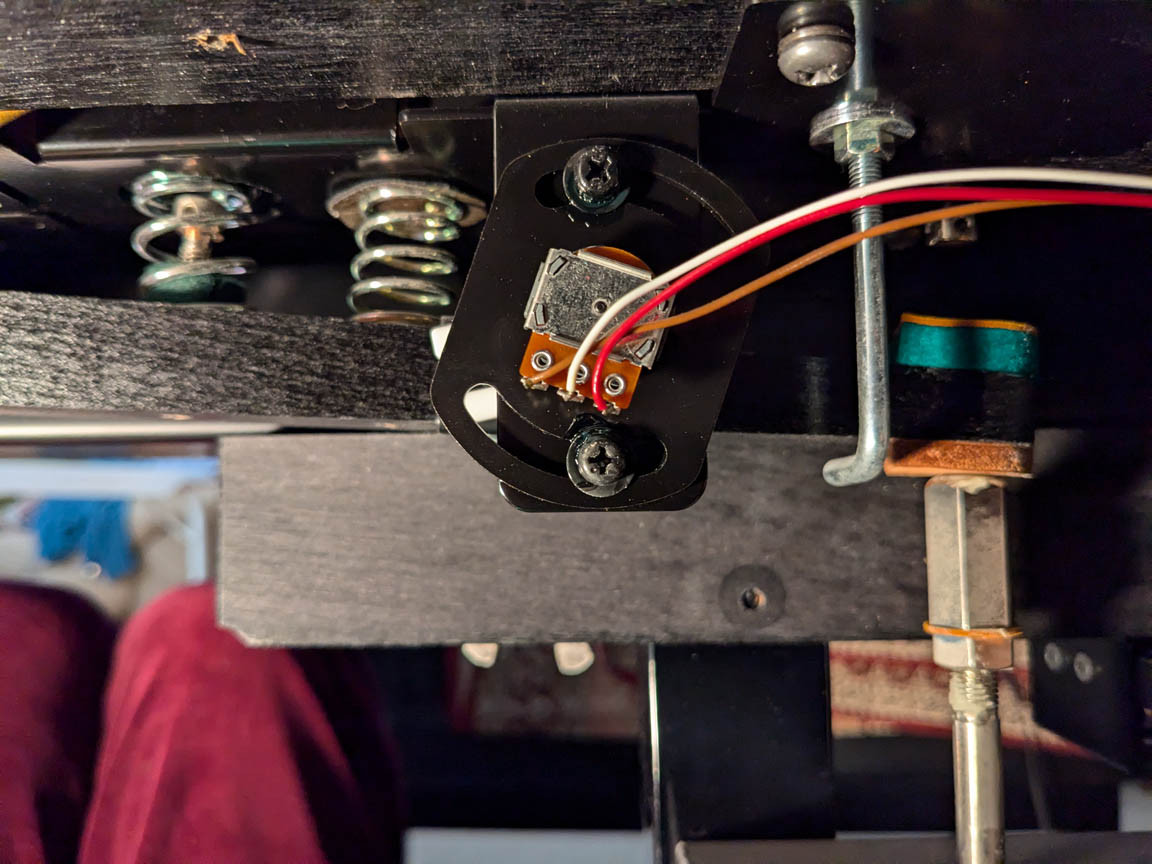
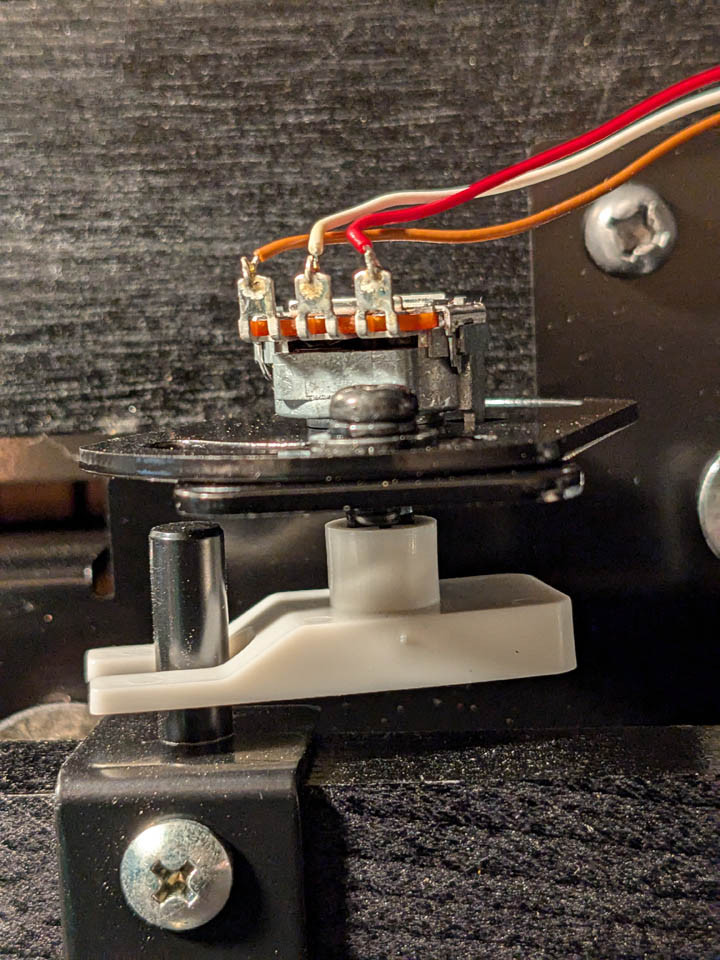
I will post pics of the pedal mechanism. I'm not a complete kutz (in my youth I worked on a variety of VTRs and VCRs during 20 years in the tech department of a television station). But there we had jigs and gauges needed for different alignments. The Yamaha manual is very paranoid with their bold type: "rotary volume installed to the pedal lever unit needs adjustment at the factory and it should not be replaced. Do not touch the rotary volume when removing the pedal lever unit." So if I can get it cleaner without having to disturb its calibration I'd prefer to do so.

Thanks to all for your suggestions.


David Lai

Jane Thanks for the update, Jane! Yes, on Reaper when I looked at the midi events, I could see the jumps. So thanks for confirming that such jumps exist. Good luck finding a workaround for your sustain pedal!


kawafanboi

just measure the pot with a multimeter in that position, max depression and open, now that you have a set of value for reference, you can take it off and mess with it.

it's probably out of calibration as is. but the calibration probably isn't the problem. it's probably the wipers.

deoxit might work, but if it's grease on the carbon track, it might not. this is not a high tech part though, you can buy another pot and make it work.


Jane

I think it's fixed, at least for now.
I originally thought it might be simple to swap the "soft pedal" and sustain pedal pots, but Yamaha inconveniently put a 3-pin connector on one and a 4-pin on the other. And I'm too lazy to spend time trying to find the soldering iron I last used 25 years ago.

I wound up disassembling things enough to get full access to the sustain pot. Decided to go with DeoxIT fader spray rather than the D5 that Jose recommended. With the pot's bracket removed I was able to get a good shot into a slot opening into the inners and to be able to rotate the pot's shaft back-and-forth through its full range.

For "calibration" I decided to use one of the self-tests built into the N3 and adjusted the bracket until the pedal outputs between 1 and 255 (it won't go to zero).

And... Modern D seems happy. Still don't know why it was the only VST I own that hated my noisy pedal.

Thanks for the suggestions, Jose et al.


David Lai

Jane I'm glad it's fixed for now. Well, not just Modern D, I'm sure Modern U and other VI Labs libraries wouldn't like your pedal before the fix either. πŸ™‚ But glad it's now normal. Hope it stays!


David B

Jane And... Modern D seems happy.

Cool! πŸ‘

Now you can enjoy one of the best virtual pianos on the market.

God Bless,
David


David Lai

David B I still love it after playing it since July when I started testing! πŸ™‚ I have all I need in this package.


dore_m

@Jane You should see the pedal data stream when it's dirty. Some softwares are more tolerant than others when the numbers coming in are all over the place.


Jose EB5AGV

Jane Caig Laboratories has an extensive set of cleaning and lubing products. I told you to use D5 as it is a generic cleaner which I have used for a long time on my work with stellar results, but specific products may be even better. Unfortunately here in Spain is really difficult and expensive to get them. There is also an specific grease for pots, but applying it usually involves full disassembly, which may be tricky.

I am glad you have got it working, good job!


_sem_

Deoxit F5 is the fader spray, or the F100L liquid. There are similar fader/pot sprays (cleaning+lubrication/protection) of other brands, Deoxit seems to cost as much as the pedal around here. Specialty stuff, often not in stock locally. Water-free isopropyl alcohol should be okay for cleaning. I understand preferably the pot axis shouldn't get soaked (may require different lubrication).


pc-king

Translated with Google.

Hello everyone!

I have used VSL Synchron Concert D-274 so far. I am a professional classical pianist. I am also a Steinway fan and like the sound of other manufacturers less. Among other things, what bothered me about VSL was:

1. Amateurish recording:

a) Noise. Clinking and clicking on some high notes.

b) Differences between adjacent keys in terms of loudness at the same velocity level.

c) Out-of-tune and poorly prepared grand piano.

d) Bad-sounding microphones. The best was "main".

2. No recording of the black keys! This was discovered because some adjacent keys had the same noise at the same velocity level and because the uncompressed size was suspiciously small. This was confirmed in a private chat. That is completely unacceptable.

3. Refusal to listen to professional pianists and provide updates.

4. Unrealistic release samples.

5. Unrealistic implementation of the sustain pedal:

a) If the sustain pedal is released while the key is pressed, the sustain pedal sample continues to sound.

b) If the sustain pedal is pressed while the key is pressed, the non-sustain pedal sample continues to sound.

c) When using the robot finger, it was forgotten that the keys are a little easier to play with the sustain pedal pressed because the dampers do not have to be raised with the force of the finger. (They are already up.) This meant that two quiet notes, pressed once in and once outside the sustain pedal, were significantly different in volume at exactly the same velocity level. Of course, you expect a fuller sound with the pedal because the other strings resonate, but it must not be massively louder. An example is Chopin's first ballad, bar 9. pianow has already mentioned this problem.

6. The demos are absolutely ridiculous and embarrassing. Why didn't they hire professional pianists?! A product like this can't be good if no professional pianist is involved. I was sad because I didn't know how many years VSL would need to carefully reissue it.

I'm going to test Modern D tomorrow (NT1). I'm already convinced that this is a big step forward. Bravo for the demos. They are good enough to show impressively what is possible. You won't find that with any other manufacturer. David would certainly have been able to show off his skills much better on an N1 or Steinway Spirio. When it comes to sound, however, I agree with johanibraaten's assessment (Oct 3), which is not 100% positive. I also think that the sound in the upper half of the keyboard could be a bit (!) more colorful, airy and lively. It's quite possible that it's the new grand piano. Or it still has too few velocity layers. I'm not even going to talk about the other competitors (Ivory, Pianotec etc.) here because in my opinion they are more in line with a cheap Casio plastic keyboard than with a Steinway D-274. I played on Steinway D for years (study, competitions) and I think Ivory 3 is a bad joke.

My questions about Modern D:

How many velocity layers? I don't agree with the above opinion that less is more. Why wasn't Spirio used? Is it not that precise? I would prefer 127 velocity layers. 1 TB is fine. :-)

Can someone make comparisons with Spirio (live recording from a Steinway Spirio D vs Modern D with the same MIDI files?

What is the current status of the issues (release samples, polyphony, sustain pedal)?

Is it lossless compressed (flac)?

Has anyone tested it with AltiVerb?

Is the sympathetic resonance added on top of the pedal resonance (which isn't what would happen in a real piano)?

Greetings!


David Lai

pc-king To answer some of your questions:

1. The official documents don't say how many velocity layers exactly was used, only that it's 34,615 samples. There are no separate pedal down and up samples, rather it's controlled live by sampled resonances. All VI Labs instruments are sampled by hand, not using robotic means. This ensures the richest way of expression. Personally, if orchestral and percussion instruments can be sampled by hand, why not pianos as well?

2. This is lossless compressed FLAC, so a big library with small size. The lossless compression uses an open source file format.

3. The built-in reverb engine under UVI is very good. I haven't used any external reverbs with it, but I believe you can play with the sound as much as you'd like, because the piano was recorded dry.

Hope this helps.

David


pc-king

David Lai Hi David

Do you know if all the keys were recorded?


David Lai

pc-king yes, it’s chromatically sampled. Also, this piano includes una corda and muted strikes (muting the string with a gloved hand while playing the key with the other).


« Previous Page Next Page »