DavisB
Re: I2C.
There's a comment in Pico SDK "i2c_write_blocking_internal" implementation that says the following:
A lot of things could have just happened due to the ingenious and creative design of I2C. Try to figure things out.
Emphasis mine. My understanding is that I2C is one of those deceptively "simple" things, that are best to be avoided whenever possible?
Hardware designers get it wrong. Module and I2C device designers get it wrong. SDK developers get it wrong.
The user (software developer) might get it wrong. Is it a 7 bit or 8 bit address, so does it have to be shifted or not, etc?
There are no built in timeout, the bus can hang, all sorts of stuff can happen.
If you put multiple such devices on a bus... it ends up being complicated. Even if you stick to the letter of the spec, there's no guarantee that everyone else will and well... (and then you put circuitry to just power cycle things... etc, not pretty)
There's also a version of i2c that fixes some of the issues called SMBus.
Sometimes you can't avoid I2C and there's plenty all sorts of sensor devices that offer I2C interface, etc.
And if there's just basic 1master-1slave write-only or read-only with 1device - like I2C OLED or some sensor - it's probably fine-ish, but otherwise...
Re: RP2350
There's RP2350-E9 Erratum which can only be addressed with a hardware revision. So I'll wait for quite a bit before switching over. (https://community.element14.com/products/raspberry-pi/f/forum/55046/rp2350-gpio-pull-down-latching-bug/223658)
Most issues with RP2040 are either known (the ADC issues as per errata RP2040-E11) and/or are addressed via hardware revisions (all rp2040 are on B2 I think) and well documented by this point.
Kind of like with the classic ubiquitous STM32F103.
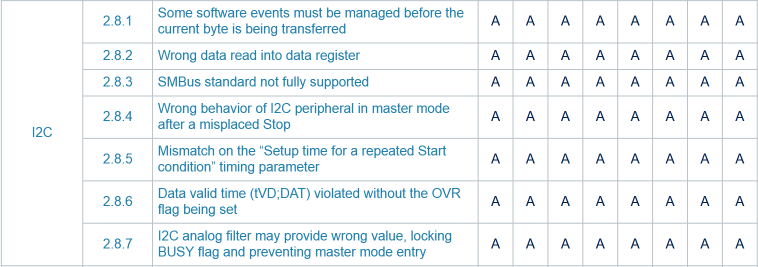
The errata is massive, here's the portion just for the i2c: