dore_m
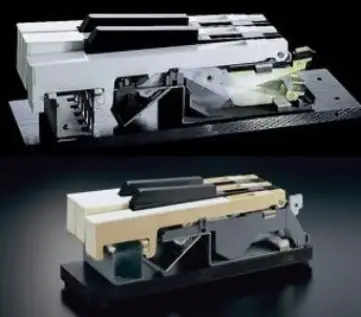
Yeah, I don't get it. Where does it get the inertial feeling of throwing a hammer? They only show a keybed.

Yeah, I don't get it. Where does it get the inertial feeling of throwing a hammer? They only show a keybed.
I guess initial reviews will give more info about it , but from a pure business standpoint , I understand why they stay relatively vague at this stage given the product is not live yet . But maybe there is a tiny chance that this is innovative . I still remember when the newton smartphone was introduced , industry reaction was to say there was no future for smartphones 😉 . From a price standpoint , I also find it way too high and looking more like a patreon type of funding . There should be a large discount for a pre order at this stage . Regarding the look, I don’t like the website pictures , but the pictures and video on their instagram account look pretty nice
Joannchr Nice! One other thing ….. did they forget to put in the felt strip?
nice craftsmanship and looks like a fun piano to design and build.
"Fully Weighted Hammer Action" and "We also radically simplified the action. With only two moving parts per key, we think it might be the most reliable real-wood keyboard ever made."
Looks like no hammers at all, even though they call it "Hammer Action". Pivot length looks really long, you can see the pcb on the side in the picture, and they responded to someone that they are using membrane switches (?)
"ONLY two moving parts per key" seems a common design: the key and the hammer.
Frédéric L "ONLY two moving parts per key" seems a common design: the key and the hammer.
😄
Yes, exactly what I thought when I read that.
Cheers and… "happy" marketing,
HZ
dore_m Pivot length looks really long
LONG??? That is an understatement... The pivot length looks like 40 cms!!! Eat dust Steinway and all your sons...
Unless... the back pin is just a stabilizer and the mid pin (the one without bushing) is the real pivot, and in that case the pivot length is in fact only 16-17 cms, which is a really stupid decision. My bet is that the mid pin is where the SPRINGS are placed (yeah springs...)
No disrespect towards Vidal but browsing through their Instagram I see they are piano technicians and with that in mind I would speculate they are just some guys who didn’t really live in the digital piano/keyboard world, they haven’t probably read a single thread in a forum like ours. I even doubt they played and tested many digital keyboards. I think they just thought how knowledgeable they must be being piano technicians, so let them create a digital keyboard with all that knowledge. I believe they are not reading the forum, as I said, so hopefully they won’t be insulted by what I think of them: they’re just ignorant. Not as a whole. As digital keyboard builders.
And I hope that thought this through correctly, because if our pivot length is REALLY long, you also need to increase a lot the spacing between the lines of the membrane switches (either 2 or 3 contacts... does not matter) to compensate for the smaller "rotational" effect of the key. If you use PCBs with a similar spacing as in regular DPs, both pads will be activated in very quick succession, which is not a problem by itself, but means that there is absolutely no room for any manufacturing irregularity. Any small tilt in the PCB or any difference in the distance of each wooden key to the PCB (hello humidity!!!) will make the midi reading jump as crazy.
and unless I'm mistaken, membrane switches are really crappy for sensing velocity. That's what they use in cheap TV remote controls. I'm no expert at DP actions - do any good ones use membrane switches?
So should I order a piano that's not yet in production? And that's been tried and evaluated by no one?
Kinda reminds me of Pelosi-era House bills. "You've gotta pass the bill before you get to read it."
Nope. Not for me.
It seems “Vidal” has been around for quite some time, yet only recently did they venture into the ‘digital piano’ business.
I must say, if their pianos turn out to be anything like their hair products, I’m all in:
I tease, yet do I?😆
dore_m and unless I'm mistaken, membrane switches are really crappy for sensing velocity. That's what they use in cheap TV remote controls. I'm no expert at DP actions - do any good ones use membrane switches?
They don't use them to sense velocity from a single such sensor. They are used as binary switches instead, placed in a specific way, so that they are mechanically pressed in succession (e.g. they are pressed by notches of different length), so that time is measured between the two activations, hence velocity can be devised. That's why there are "two-sensor" and "triple-sensor" actions.
vagfilm And I hope that thought this through correctly, because if our pivot length is REALLY long, you also need to increase a lot the spacing between the lines of the membrane switches (either 2 or 3 contacts... does not matter) to compensate for the smaller "rotational" effect of the key.
From the photo, the fulcrum seems to be at the far rear side and the sensors (the little green part of PCB we see) half way. Then there are still some movement to measure (half the shift of the front of the key). Note, sensors don't measure a "rotational" effect. Only a movement of the part of the key on the top of it.
Frédéric L Note, sensors don't measure a "rotational" effect.
I know that... You did not follow my argument (maybe because I did not explain myself well...). As CG mentioned above, these membrane switches don't measure absolute time but difference between successive activation of two switches: when the key is pressed, it first activates the back switch and then the front one (and also mid sensor, in 3 sensor actions), and these are usually only a few mms apart. If the pivot is short, the key bottoms at a steep angle (what I called rotational effect); if the pivot is long, the angle is shallow. In a theoretical infinite pivot (same displacement at the back and front of the key) you simply cannot use successive sensor strategy because the sensors are all activated simultaneously. Thus, membrane switches are a bad strategy if you have optimal pivot length, unless you place one switch close to the fulcrum and the other close to the key front.
vagfilm In a theoretical infinite pivot (same displacement at the back and front of the key) you simply cannot use successive sensor strategy because the sensors are activated simultaneously.
What you need is to have sensor close enough to the front of the key, or if you prefer far from the fulcrum.
Then here with sensors half way between the front and the fulcrum, the movement seen by sensors are half the movement of the key front. I can be enough whatever the key length.
With an infinite length key, the sensor can't be closed to the fulcrum, and is relatively very near the key front. Then When the front is depressed by 5mm, the sensor will see 5mm of movement. It can't be better.
Note the sensors will be mounted at different height, then they are activated successively.
Again, missing the main point of my criticism which does not have to do with electronics (sensors are fast enough to measure successive pressing even if put in the worst location) but with manufacturing tolerance. Using this design is not a problem for sensing a single key. It is a problem (or may be more problemtic, to be correct) for calibration across keys. Sensors in close proximity require strict manufacturing and assembly because there is less tolerence. If the pcb under one octave is tightened with one more turn of the screw and the pcb rests a quarter of mm further from the key than in other octaves (it takes usually several pcbs to cover the 88 keys) that causes a large difference in velocity reading. On the other hand, if the sensors are very far from each other, there is more room for assemblage differences. Better tolerance, easier calibration.
what's providing the counter force ?
is it spring loaded, or are those round things underneath next to their dome board magnets ?