Frédéric L
The NWX action from the P515 is here :
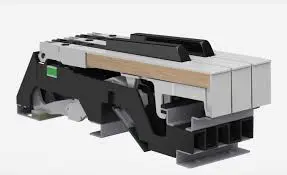
It is quite close to the GH3X excepted the wooden core. The NW is only a NWX without escapement simulator.

The NWX action from the P515 is here :
It is quite close to the GH3X excepted the wooden core. The NW is only a NWX without escapement simulator.
Frédéric L The NWX action from the P515 is here :
Where did you find that picture? I love that Kawai is very clear about their actions, whereas Yamaha is extremely secretive and confusing wrt to what-is-what
Frédéric L It is quite close to the GH3X excepted the wooden core. The NW is only a NWX without escapement simulator.
Ditto. Where did you get that information? Also, does anybody know what the difference is between the similarly named Balanced Hammer Standard, Balanced Hammer Effect and how do they compare with Graded Hammer, Graded Hammer Standard, Graded Hammer Effect and Graded Hammer 3? I know about https://usa.yamaha.com/support/faq/keyboards/6575.html but that does not say basically anything, other than "the GHS is the cheaper, the rest are different and all premium, if you buy from us you won't be dissatisfied"
Yamaha have used the GH moniker for ages while it has been often mentioned that these actions went through various revisions and improvements.
It’s Yamaha after all.
Indeed the Yamaha information is utterly hazy and therefore (to me) frustrating.
Over these past weeks, this afternoon included, I tried all CLP-7xx actions and the P-515 action and GHS (that latter one not really a test because I knew it already). Last week I somewhat thought I liked the action in the 745, however, this afternoon I didn't at all. So, no digital Yamaha action for me (not counting the hybrids).
This afternoon I played a Yamaha C7X (factory new instrument) and… I liked the action, the control and the instrument a lot 😇. Very nicely balanced in all sorts of aspects and very playable. Rather different from the C7.
Also played the 1892 Blüthner 180 again… and that is and stays top-level candy 🧁. Men oh men is that a special instrument. Also highly playable even though it requires a different approach from, say, that C7X.
Cheers and happy playing,
HaZy
I think I have get a wrong illustration from a P515 article, sorry.
However, https://www.pianodreamers.com/yamaha-p515-review/ Has a more trustworthy photo I have already seen elsewhere. The rods under the Yamaha keyboard is typical of their actions.
It's still unclear what the difference between NWX and GH3 is, except for the wood in the NWX. Are they mechanically the same, like having the same type of hammer weight, size, position, movement, sensor actuation, etc.?
And then, where does NW-GH3 sit? 😀
I will have to make another visit to our local Yamaha store, now that I have fresh impression of the NW-GH3 in my CP88 and compare it against the NWX in P515. If my finger memory serves me well, I think the NWX in the P515 has some initial friction in addition to the weight inertia from the hammers. If that's true, they emulated the friction in real piano actions although I don't find any perceptual friction in my N1X. The NW-GH3 on the other hand has no initial friction.
I had a very curious experience this morning when I woke up and (as I said the piano is now next to me in our bedroom 🤦🏻♂️) reached for it to play the keys while the piano was turned off. My initial impression was: hell, that is too heavy and unnatural, why did I purchase it 😀 Then I switched it on and started playing and it was totally different! The keys and their inertia felt exactly right and I wouldn't say they were unnecessary heavy at all! I believe the key to sound connection is very important for how a keyboard ultimately feels. Yamaha really nailed the touch response. As a side note, I always had this problem with all the Kawai digital pianos I owned: their keyboards felt great when turned off, but once I started playing, it was always an odd experience with unnatural touch response, jumping velocities, exaggerated response, way too easy to produce loud volume which combined with the low key weighting resulted in a rather underwhelming experience. On the other hand, the Yamaha pianos have always had a very good key to sound connection and although people would describe the keys almost unequivocally as "heavy", the final piano experience is a very satisfying one.
All that being said, the CP88 is no match against the N1X. The N1X is just so much better!
Frédéric L
I think the previous one was a Roland action...
CyberGene My initial impression was: hell, that is too heavy and unnatural, why did I purchase it 😀 Then I switched it on and started playing and it was totally different! The keys and their inertia felt exactly right and I wouldn't say they were unnecessary heavy at all! I believe the key to sound connection is very important for how a keyboard ultimately feels. Yamaha really nailed the touch response….
This!
Here’s a quote from the Yamaha website:
CP88 features an 88-key Natural Wood, Graded Hammer, triple sensor (NW-GH) keyboard with Synthetic Ebony and Ivory Key Tops – the fastest stage piano action on the market designed by a company with over 100 years of acoustic piano-making experience for professionals who demand the best.
Natural Wood keys offer the weight and response that piano players expect. Adding different weight or "grading," the keyboard reproduces the feel of a piano's hammers: heavy in the low end and light in the high end. Synthetic Ebony and Ivory Key Tops are lightly porous which adds grip to the keys. This maintains accuracy during long performances or practice sessions.
Finally, a third sensor allows grand piano-like key repetition where notes can be re-articulated without a complete release. This makes it easier to play fast, repeated notes and is one of the main reasons pianists choose grand pianos over uprights.
Pete14 CyberGene My initial impression was: hell, that is too heavy and unnatural, why did I purchase it 😀 Then I switched it on and started playing and it was totally different! The keys and their inertia felt exactly right and I wouldn't say they were unnecessary heavy at all! I believe the key to sound connection is very important for how a keyboard ultimately feels. Yamaha really nailed the touch response….
This!
About that This!, for somebody like me trying to follow along and understand this This, if the keys felt too heavy / unnatural turned off, but then felt exactly right after turned on, even i can narrow down the reason to one of two apparent possibilities, keeping in mind that any things in this world are not always as they seem. Sometimes there may be deciding factors unseen but perceivable nonetheless for a mind with enough acuity.
The one that most easily appears to be the reason with your DP cannot be given the action technology currently in use. This leaves one possibility: somehow, the turning on, which added an element (sound) to perceive that was not present turned off, changes the perception of how the keys weight/inertia are perceived between turned off and on, and this is what some pianists refer to as a DP’s feel/sound connectivity …. I think ….. but your new DP is bedside ….. are you SURE you were awake CG?
After some more time with the CP88, I can say I really love the board and all my initial impressions still hold true. For what it is. However I'm not sure I really like the action. I generally have problems with digital actions pushing constantly against your fingers and I seem to not be able to overcome this feeling, it just annoys me. Furthermore, this particular action is heavy and has the infamous "initial friction", so yesterday I was trying to play some slow jazzy stuff with very thick chords where I often use my thumb to press two keys at a time and I struggled, I simply missed notes. On my N1X I can so easily play ppp with my thumb pressing two keys, however on the CP88 attempting to play very quietly double keys with a single finger feels almost like the keys are stuck and don't move 😢 To a certain degree I think I hate all digital piano actions and am rather willing to use lightweight synth actions for a gigging board. I really loved the waterfall action in the YC61 and if there was a board with either 73 or 88 keys, I would have purchased it on a whim because it would also be very lightweight.
P.S. I don't want that to sound as a complaint. It's a gigging board for stages, for playing in a (loud) band context. When I play it with more force, it feels OK and doesn't annoy me. It's only when I try to play softer solo piano passages where it struggles.
One of the things I noticed and liked about the N1X was how effortlessly I could play pp, trills, etc; and how natural/musical the transition between pp to ff sounded. I also found the action just right in terms of weight (not too heavy, not too light), and the connection between action and sound engine was simply superb; I’ve been in love with this instrument ever since.
I had also tested the N1 back when it first came out, and the experience was the opposite: sluggish action/sound connection, mediocre sampling, not-so-easy/natural transition between pp and ff, etc; I really did not like that instrument, nor the N2.
The X variant appeared just a minor update, and Yamaha didn’t seem to make a big deal about it, but something about the sampling/modeling, and the overall action/sound connection took this model to a whole other level, and I don’t think this is simply due to the CFX/VRM (although that’s important); I think there’s something more going on, in general, that made what appeared to be ‘a minor update’ into something very special.
CyberGene However I'm not sure I really like the action. I generally have problems with digital actions pushing constantly against your fingers and I seem to not be able to overcome this feeling, it just annoys me.
Just out of curiosity: gigging convenience and UI aside (which you like in the CP88), did you also have those problems with your old ES8?
vagfilm it is ES7. Speaking strictly about the action, it still has that constant pushback against your fingers but the hammer weights are lighter and as a result I didn’t have problems with pushing two keys lightly with one finger. On the other hand the light hammers made it easy for me to reach high velocities and thus the touch response was always kind of exaggerated even when I changed the touch settings. I believe these are two approaches that both have their cons and pros on digital pianos: opting for a heavy action that has similar inertial qualities to a real action at the price of constant, spring like pushback against your fingers. Or opting to light weighted action that doesn’t exert such a resistance when playing lightly but then has unrealistic lightweight response and too low inertia that can’t be mapped properly to samples obtained from large grands with huge dynamic response that is a result of heavy real hammers…
The CP88 is such a great professional stage piano! I was lucky enough to use it when it just came out and the piano sound was big and fat and expressive in concert. My friend had one and when I played it again, all kinds of cool licks came out because the board just sounds great! The piano, EP and pads are exceptional. I better stop or else I will buy one for myself and curse it when I have to carry it around or drop it.
Either I got used to it or the action needed some breaking in but the action doesn’t exhibit this “initial resistance” stuff anymore, for which many Yamaha actions are (in)famous for. It’s an action that I thoroughly enjoy now. Well, it’s not in the N1X league but I doubt anyone expects it to be. I’m really happy with the CP88 as a stage piano that I’m currently using for pop/rock jamming with some friends.
And BTW, I’m in total love with the U1 upright samples, they bring very realistic and down to earth, humanly sounding upright piano that is perfect for more casual music genres. Yet, I also find use for almost all the acoustic piano samples. I’m in love with this board! ❤️
The CP88 has got a really nice vintage look. I’m sure it rocks on stage . Used to gig every week end in pubs with its old grand father the CP33 😉 nice memories . This stuff never lets you down .
about encoders, not the case here, but sometimes if they're stored at a weird angle, the oil can pool to 1 end of the enclosure, and it feels all smooth, but when you get it oriented right after a few days it tightens up.
And now to the downsides. Even though at 18kg it’s not the heaviest stage piano, I have a herniated spinal disc and after our last jam two days ago, having to haul it around with another synth and a double stand, I still have residual pain in my back 😢 At this point I’m really considering downgrading again to a YC61, losing octaves and most importantly losing a wonderful hammer action in exchange for a waterfall one but I’m not a serious gigging musician, so I may have to sacrifice something else but my health 😕 And I don’t play the CP88 at home since I have the N1X.
Sorry to hear about that, but you are right 18kg , is sill on the heavy side given the mass repartition. Imagine if you had an Mp11 !!
