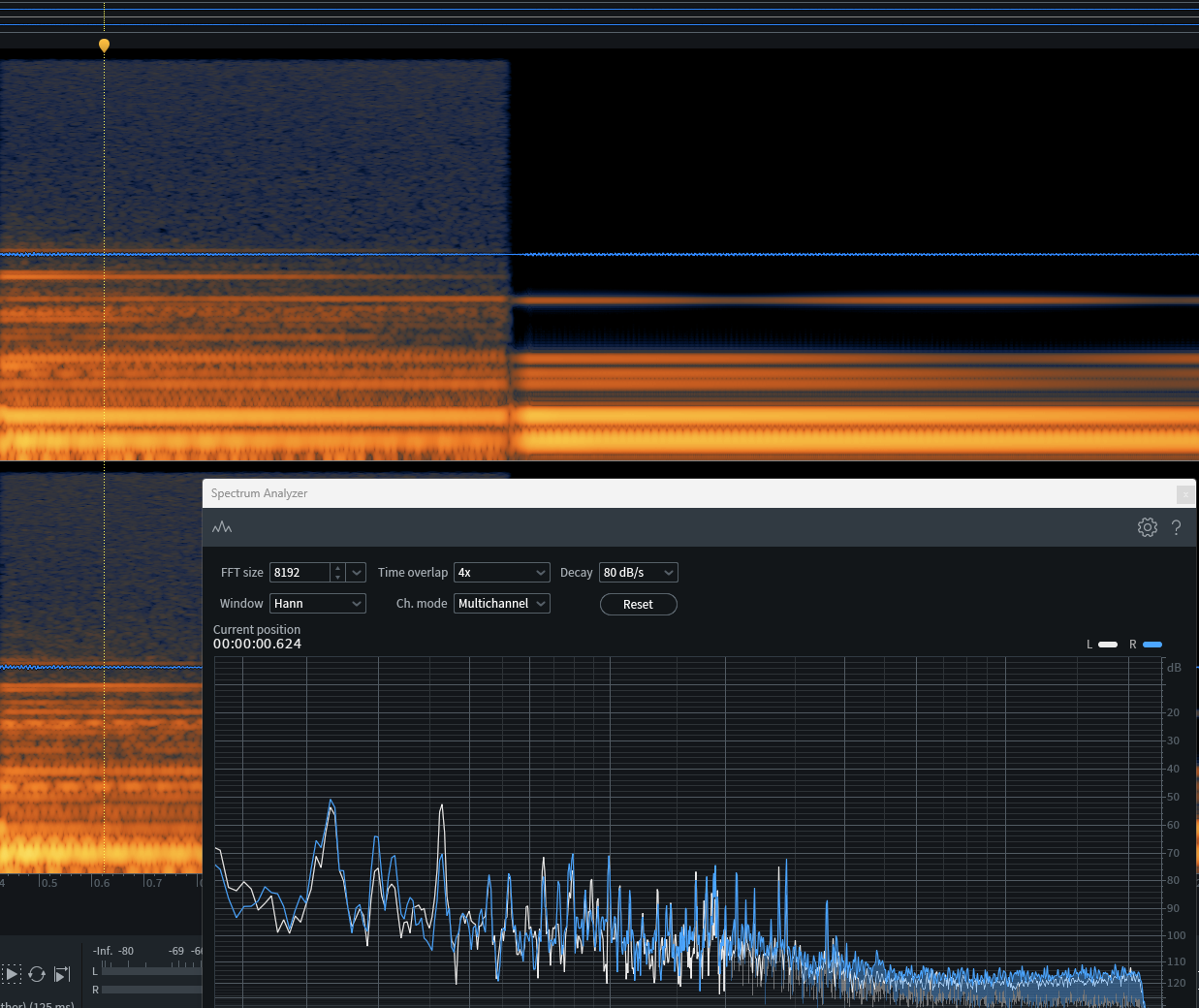
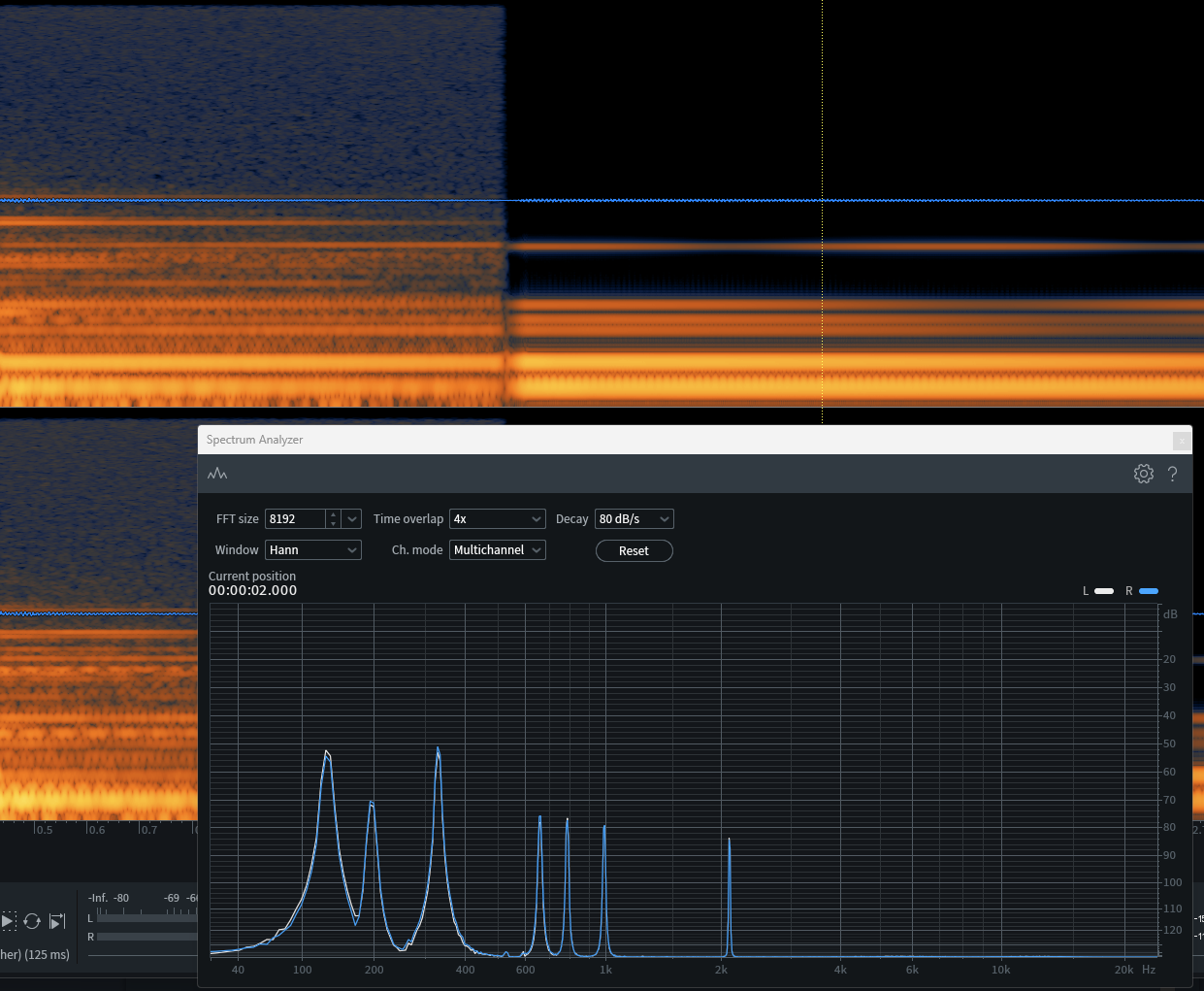
I thought I'd throw some technical stuff in here, since I literally have it up on my computer. I'm trying to use LLM's to help re-factor my code and I'm optimizing the Sympathetic Resonance module, which uses additive synthesis (adding sine waves at appropriate frequencies) and that is essentially what Pianoteq does. I'll enclose two audio samples. The first is a sympathetic resonance of a Steinway B - Silent C2 string open with struck A2. Note the audio as you can hear the struck note fade quickly and the remaining sustain is the SR. The second audio file is that real SR spliced in front of my re-creation using sine waves (loop it or play it over and over to compare). I'm currently adding more sine waves (and trying to automate it) to get closer. But you can hear how close it is already. And the picture is the spectrum. Left is the real SR and right are the sine waves. You can see that to recreate the real sound I would need many many sine waves. But how many is enough? When does pianoteq get so good you can't hear the difference? In any case, I've got a long way to go to be perfect - but luckily SR doesn't need to be perfect since it's a secondary effect.
steinway-c2-a2-real-sr.mp3
steinway-c2-a2-comparison.mp3
Spectral content left side real SR (more yellow bands, more peaks in spectrograph)
Spectral content right side for sine wave simulation (less yellow bands, easily seen sine wave peaks)
Apologies to @David Lai who can't see the graph. But I'm sure you can hear it as an attempt at recreating the real sound, yet imperfect.
(Note, stereo image is definitely different. just listen for frequencies)