RIP
It has been suggested to me to move some DIY posts which are not worth of their location to somewhere else, so I'm complying. The following one used to be #143745

It has been suggested to me to move some DIY posts which are not worth of their location to somewhere else, so I'm complying. The following one used to be #143745
DavisB can be built with lower BOM and lower labour/assembly time costs (certainly with SMD PCBA)
Nice to see you continuing progress with your project. Let me ask you a question because I'm a bit confused about your goals here, and the (very few) times I give you answers I may be misleading you if I don't truly understand your goals.
You often talk about the price/cost, in a way that seems excessive to me, as in the Raspberry conversation I've just replied to. I mean, obviously you want to keep costs under control and not spend a million dollars on such a DIY project, but are you designing something for future mass production in which saving $10 will be multiplied by hundreds of thousands of boards and become real money? That seems unlikely, but I have to ask to understand and be able to communicate effectively what I think. Or are you really so short on money for your own single execution of this project that you really need to save that few bucks or you don't have enough to complete it? That also seems unlikely (otherwise you would be buying a low-end keyboard, perhaps used, and be done with it)! I mean, given the time and other resources (soldering and CNC equipment) you are putting in this project, I'd expect you to be willing to put the most advanced things you can put in (like all the others before you have done, including myself), not trying to save less than the cost of a fast food lunch. So I'm very puzzled about your choices and I wonder if my answers to your comments are not helpful because I'm missing something.
I don't watch YT with very few exception and I may have told you this already, but this came to me and exactly capture what I wrote above in a much clearer way that I can say
https://www.youtube.com/watch?v=4jgTCayWlwc
And to conclude, in case this comes out a little be rude, let me be clear: none of this is my business, it's your hobby project you you obviously can do whatever you want and I have no say into it, nor I am entitled to ask such question and you can well not answer that that's fine.
I am asking anyway because if you're willing to share your thought process, I will have a better understanding and maybe I can share things that don't completely "pull" you in the opposite direction to where you want to go 🙂
Random talk. Going to replace all the sensors with new boards. Same HPS design but my piano is using a mix of sensor boards from past experiments and its time to make them all the same.
gzpiano Going to replace all the sensors with new boards.
Very cool. My efforts have been stalled for personal reasons, but I hope to pick us steam with the longer days 🤞
pushed a new set of feature enhancements to the open hybrid piano GitHub repo.
gzpiano pushed a new set of feature enhancements to the open hybrid piano GitHub repo.
Quite a lot of stuff, I saw that. I'll need some time to digest it, thanks for pinging!
closing out more issues this weekend
opened/closed over 100 issues since getting all FW, HW, and SW fully into GitHub in 2023.
The piano design is getting quite reliable!
https://github.com/gzweigle/open-hybrid-piano/issues?q=is%3Aissue
Sorry to change the subject, but it's still DIY random talk.
I've not been able to make a definitive escapement simulation yet. I had bought some silicone, but it turned out to be too soft, providing no resistance to the hammer. I did a quick research on hardness scales and learned about Shore A and D hardness scales. Silicone stuff here usually has Shore hardness specified, though which Shore scale is seldomly stated. I assume it's, at least, standardized. Anyway, now I have to choose some other silicone rubber or caulk based on its hardness. But I don't want to buy the wrong one. I have no idea how hard (I mean, how soft) is the escapement rubber in Kawai actions, which is what I'm basing on. There's a certain amount of leeway on how hard the escapement bump should feel. On one baby grand I have regular access to (a Kawai KG), it's almost like a click, like if you're too soft, the key will stop you. On the other hand, another baby grand from a different brand I came across (probably a stencil brand) has a bump that's not that strong.
I'm open to suggestions on creative ways to simulate escapement behavior. I'm also using magnets in order to alleviate touchweight*. I could just ignore the escapement bump and print on the rest of the keyboard, but I don't want to move on without settling this detail.
*I don't get why the Vidal people choose to put the magnets near the pivot. Wouldn't that have the screws in the keys entering the magnetic field sooner instead of in the ending of the key travel? Wouldn't one want a bigger arc length? What am I missing here?
CrisOliveira There's a certain amount of leeway on how hard the escapement bump should feel.
In my opinion for a non-hybrid action you can forget the escapement simulation and live without it. Many people, including our own @David B remove it from commercial keyboards!
That's your call, obviously, but not putting it in is what I would do. Also because the escapement simulation is "always there", whereas the real escapement can be felt only in soft playing (at least on the grands I have access to): when playing above a certain velocity, say from mf and above, the hammer is moving fast enough that it escapes by itself and I don't feel any "bump" in the keys. I am not aware of any non-hybrid design which can reproduce this, so I'd rather not have it at all.
CrisOliveira I don't get why the Vidal people choose to put the magnets near the pivot.
I didn't study their action in detail. From cursory look, I liked their earlier design better than their current one, and to me their justification for the switch sounded like "oh the old one was too complicated and therefore too expensive, so we gave up". Which does not instill confidence in them, since they had earlier said that such design was the best thing ever…. All of this to say, don't worry too much about what they are doing….
RIP Also because the escapement simulation is "always there", whereas the real escapement can be felt only in soft playing (at least on the grands I have access to): when playing above a certain velocity, say from mf and above, the hammer is moving fast enough that it escapes by itself and I don't feel any "bump" in the keys.
I don't know about Kawai, but with my Roland, I can't feel the bump when not playing soft either. I always supposed that despite being always there, the simulation was not noticeable when playing from mf up.
"Always" is funny, since two years ago, I didn't even know what escapement was... It feels like ages ago.
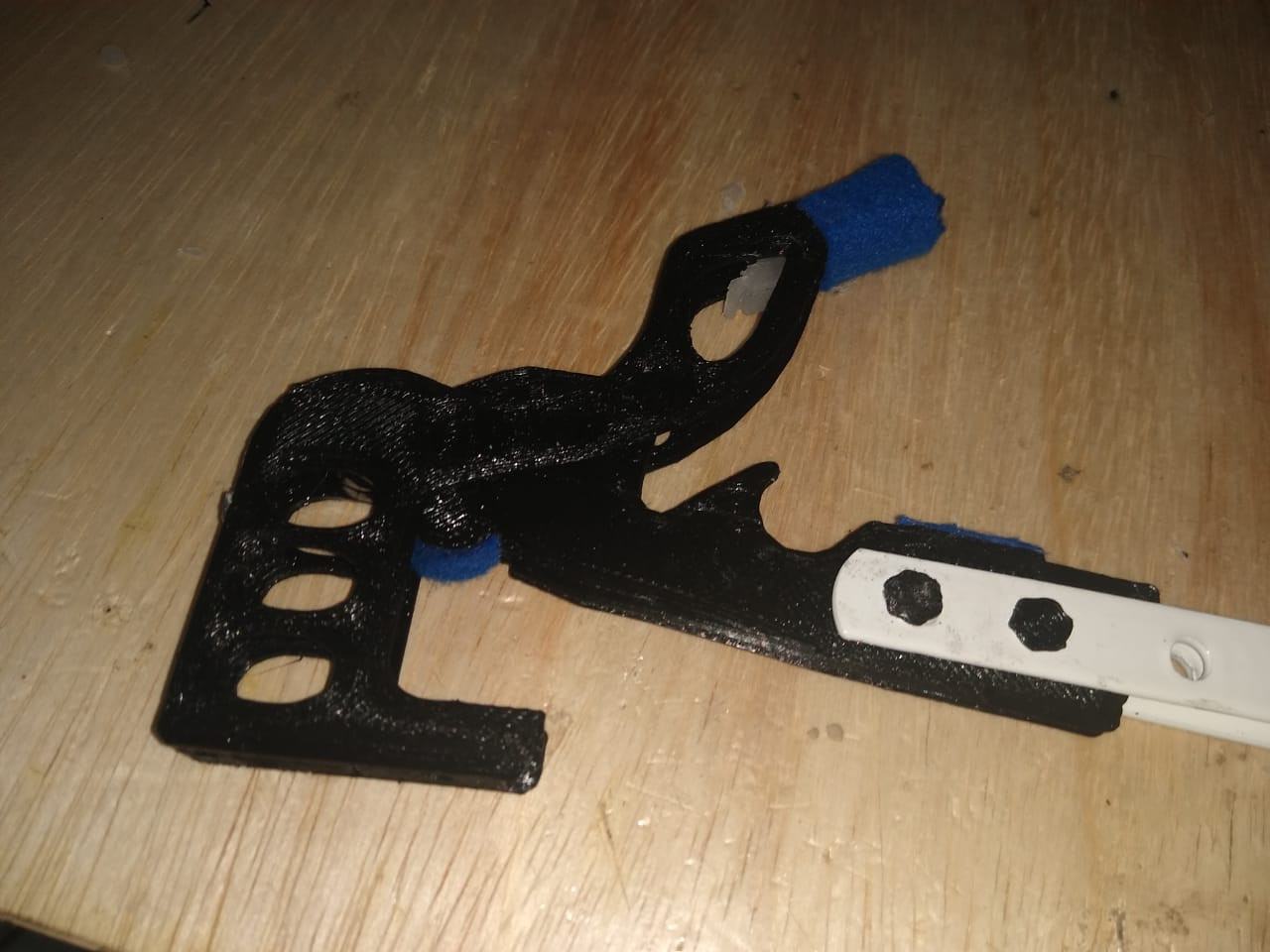
I succeeded at creating a escapement rubber bump. I molded hot glue (silicone, afaik) into the shape. And I introduced a little change in the hammer's design: the lip that crosses the rubber bump is now in the shape of a hook, so as to minimize friction in it's way downward and not to get stuck after the key is released. The hammer's weight now concentrates downward at the point of contact, allowing it to go back in place.
I quick search shows me that CyberGene wouldn't be happy with this feature. 🤭
random talk….. I bought a second grand piano action and am having it rebuilt. So can play my existing open source hybrid piano while having a second for further engineering ideas.
gzpiano I bought a second grand piano action and am having it rebuilt.
Wonderful!
Let me nudge you once again (I know I sound like a broken record) to try technical extrusions (for example from Misumi) rather than the home-depot-grade extrusion. I'll bet it'll solve at least some of your stability problems.
I may actually have some spare that I can send to you (contact me privately with the lengths you need to see if there is a match).
Are you also sticking to the original CNY70 or are you exploring other sensor options, and if so which ones?